
I bought the Vatic Pro Prism in early April, after a Wednesday doubles session where my dinks kept popping up over the net and I lost the last game right at the kitchen line. Nothing dramatic happened. Nobody laughed. But I drove home thinking the paddle in my hand was not doing me any favors, and the wooden-core set I started with had run its course. I am 59, retired from UPS after 31 years on a route, and I play doubles three mornings a week at the Knoxville city rec center. Around a 3.5 on my best day. Seven months later, the Vatic Pro Prism is still the paddle I pull out first.
Carbon fiber gets talked about like it belongs only to tournament players. It does not. What it changed for me was the boring stuff: where the ball goes when I do not hit it clean, and how my right elbow feels the next morning. I am not going to tell you it will raise your rating, because it will not. What I can do is lay out the ten things that made it worth keeping in the bag, and a couple of things that might send you looking elsewhere.
The paddle I have not swapped out since April
Carbon fiber face, 16mm thick, foam-injected walls, about 8 ounces, and a cover in the box. That is the short version. The ten points below are the long one.
Amazon Check Today's Price on Amazon →A real carbon fiber face makes mishits less of a surprise
My starter paddle was wood. When I caught a ball out near the edge, the whole thing buzzed and the ball squirted somewhere I did not plan. The Prism has a carbon fiber face, and edge contact comes off flatter and more predictable. Not magic, and not a bigger sweet spot on paper. Just fewer surprises. For a rec player who catches the edge two or three times a game, that is worth something every single session.
16mm of thickness buys you a beat to aim
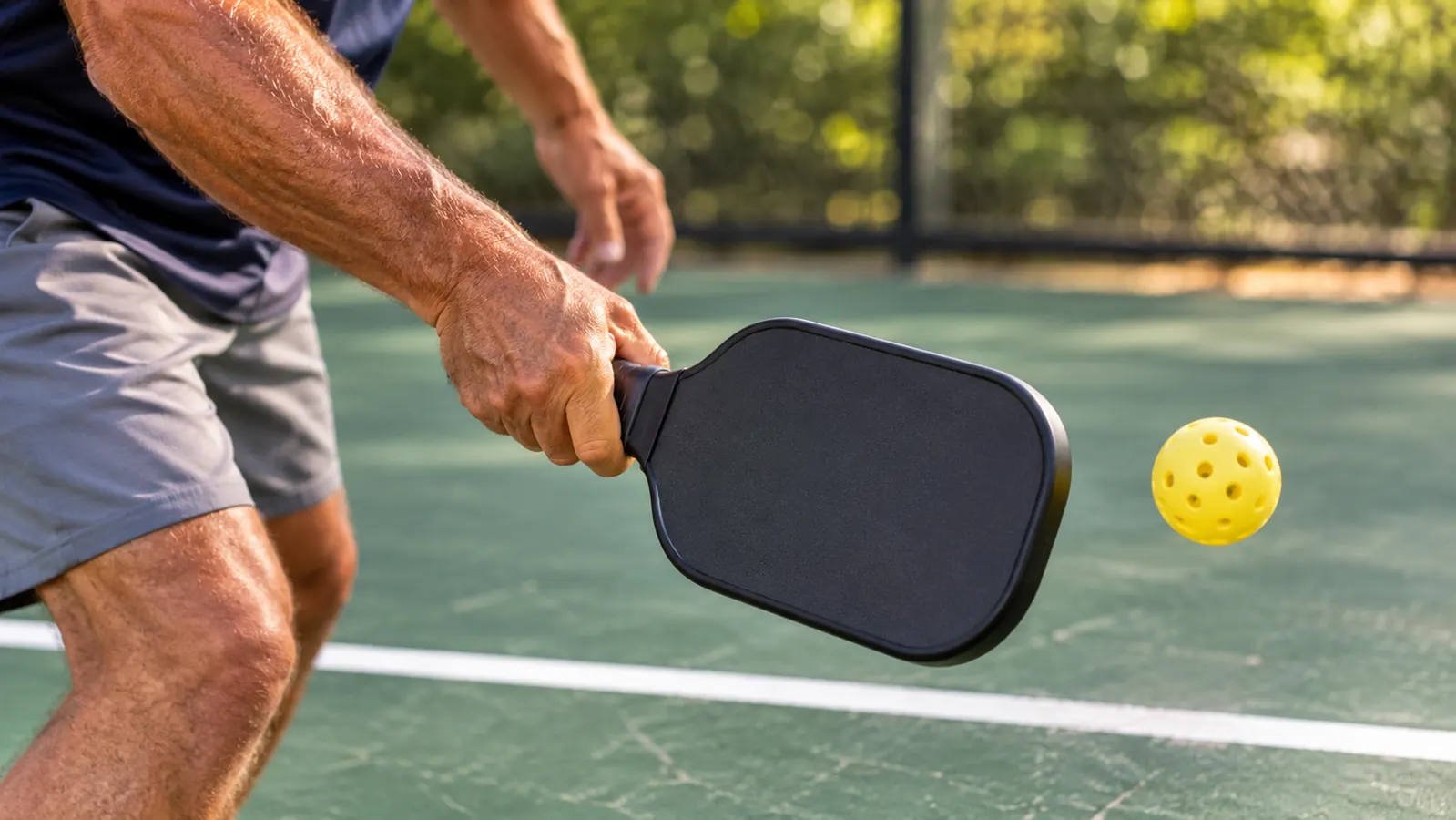
Thin paddles feel fast, but the ball leaves in a hurry. At 16mm the Prism holds the ball a fraction longer, and that fraction is where a dink either clears the net or does not. My kitchen line game got better because I had time to be deliberate. That is the honest version of it. The paddle did not put touch into my hands. It gave my hands a little more time to use whatever touch they had.
Foam-injected walls take the ring out of the handle
The listing says foam-injected walls. All I can report is what my hand feels. My old paddle rang like a hollow door on an off-center hit. The Prism thuds. I have a sore right elbow from years of lifting packages into a brown truck, and some mornings I wear a strap. I will not tell you a paddle fixed anything, because it did not. I will tell you the Prism felt calmer in my hand than the starter set, and that is why I kept reaching for it.
About 8 ounces leaves something in the tank by Friday
The Prism is listed at 8 ounces. By the third morning of the week my arm used to feel like I had been carrying a scanner all week. At 8 ounces I can play Monday, Wednesday and Friday and still lift my coffee on Saturday. If you are coming off something heavier, give yourself a session or two. Light feels strange at first and you will over-swing for a while.
Cold-molding is why the face plays soft instead of springy
Vatic Pro makes a point of cold-molding the Prism rather than baking it at high heat. I cannot see the process from a rec center bench, so take this as a feel report instead. The face plays soft. Drives still travel, but the paddle does not add pop nobody asked for. If you want a trampoline, this is not that paddle. If you want the ball to go roughly where you aimed, the softness is the whole reason to buy it.
The Prism did not put touch into my hands. It gave my hands a little more time to be deliberate.

A 16.3 by 7.5 footprint gives you room to be wrong
The face is listed at 16.3 inches long and 7.5 wide, and that matches what I see when I set it beside my old one. Nothing has been shaved off the width to make it look quick. In doubles, where most points are decided by who misses last, a face with a bit more real estate is kinder than a narrow one. I still miss. I just miss less badly.
It ships with a cover, so it does not ride bare in the bag
Small thing that turns out not to be small. The Prism comes with a paddle sleeve, and the sleeve is what keeps the face from picking up grit off the balls and the fence hook. My bag has five pockets and a hook, and there is still sand in the bottom of it. A cover costs almost nothing to include and saves the face a season of scuffs. It came in the box, so I used it.
USAPA approval matters more than the sticker suggests
The Prism is USAPA approved, which is the list sanctioned play goes by. I am not a tournament player and I do not pretend to be. But if you ever sign up for a league or a ladder where the rules count, you do not want to hear at the desk that your paddle is not on the list. That is a bad way to start a Saturday. Approval is boring until the day it is not.
One paddle handles dinks and drives, so you stop switching
The listing puts skill level at all, and I believe it. At the net the Prism is soft enough to dink. Back at the baseline it is stable enough to drive. Early on I swapped paddles depending on the drill, which is a fine way to never learn either one. Seven months with the same paddle means my hand knows it now. That consistency is worth more than any single line on the spec sheet.
A 30 day manufacturer warranty is short, and it is stated
Vatic Pro lists a 30 day manufacturer warranty. That is not a long time, and I am telling you because you will see it and wonder. It covers defects, not wear, and the face of a paddle you play three times a week takes wear. Buy it knowing that. Seven months in, mine has held up. No dead spots, no rattle, nothing loose at the edge. That is a report from one player, not a promise from me.
What I'd Skip
If you are three weeks into the game and still deciding whether you like it, skip this. I played my first real months with a fiberglass paddle I bought in March, and I lent it to newcomers at open play until it became my backup. It was fine. It is still fine. A carbon fiber face rewards a player who already knows roughly where the ball is going and wants it to go there more often. If you are still learning to keep the ball in the court, the paddle is not the thing holding you back.
The other skip is anybody chasing power. The Prism is a control paddle, and it will not turn a soft second serve into a weapon. And one more thing, said plainly. If you have elbow pain that lasts past the morning after you play, talk to your doctor. A paddle is a piece of equipment. It is not treatment, and I am not qualified to tell you otherwise.
If your dinks keep floating, start here
Carbon fiber face, 16mm, foam-injected walls, listed at 8 ounces, USAPA approved, cover in the box. It is the paddle I have used every session since April.
Amazon Check Today's Price on Amazon →