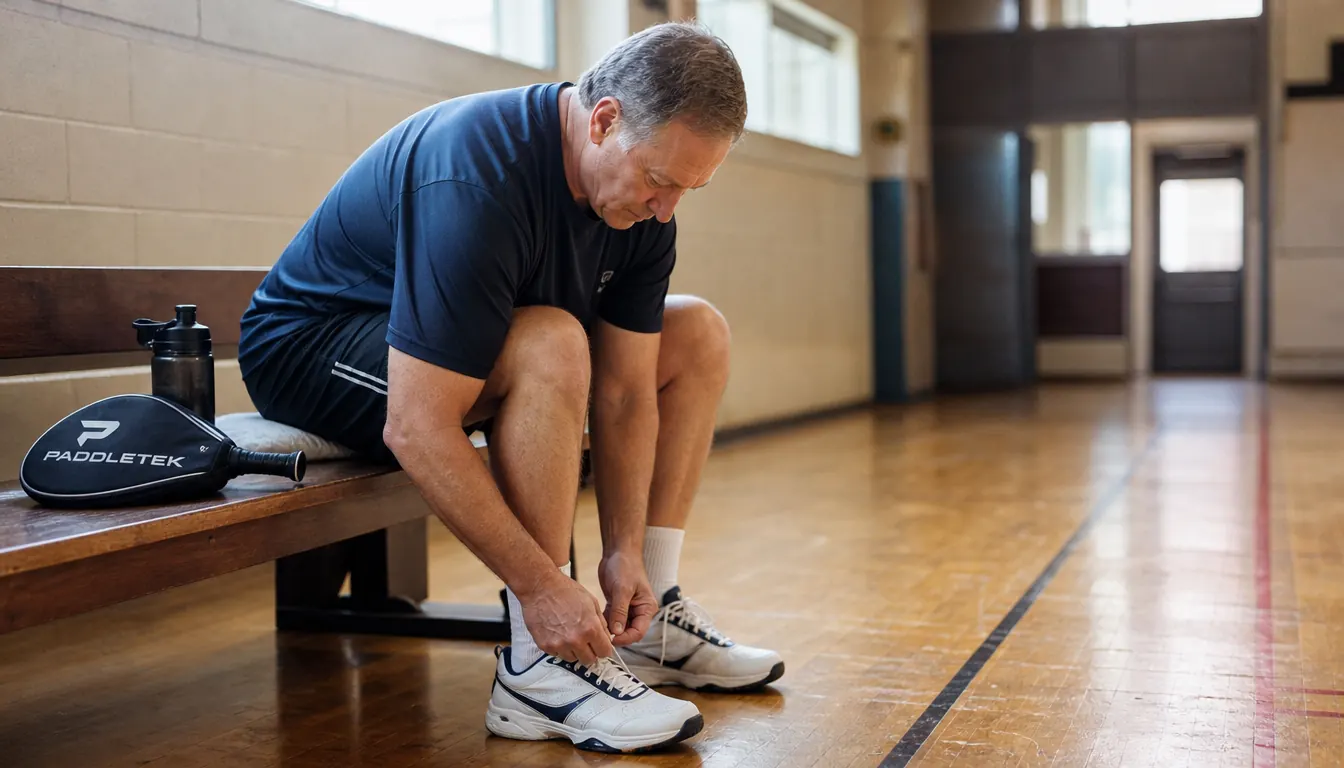
I bought the Skechers Viper Court Smash in early May, four days after I slid across the gym floor at the Knoxville rec center reaching for a drop shot. My feet went one direction, the rest of me went another, and I caught myself on a net post with about twenty people watching. Nobody said a word. That was worse than if somebody had. I am 59, I retired from UPS in 2023 after 31 years on a route, and I play doubles three mornings a week. I am not quick anymore. But I am not clumsy either, and I knew the problem was not my feet. It was my shoes.
What I had been wearing was a pair of running shoes. Fine shoes, built for pavement, with a heel that sat up high and a tread made for asphalt. On wood they had about as much grip as a paper plate. I had put off buying court shoes for a year because I figured a shoe is a shoe and I was not going to buy a second pair for a gym I visit three mornings a week. That logic lasted right up until my hip hit the floor. The Skechers Viper Court Smash is not a complicated product. It is a lace-up court shoe built for pickleball, tennis and racquetball, and the difference it made for me came down to one thing: the bottom of the shoe.
The Quick Verdict
Grip and cushion where an older rec player actually needs them. If you play indoors at all, this is an easy yes. If your current shoes still have tread and you never touch a gym floor, you can wait.
Amazon Check Today's Price →The Pair I Wish I Had Bought Before That Gym Floor
One lace-up court shoe, built for pickleball, tennis and racquetball, worn indoors and out for a full season by a 59-year-old who plays the right side three mornings a week. Check the current price and the size run before your next open play.
Amazon Check Today's Price on Amazon →How I've Used It
I bought one pair in early May and I have worn them for every session since. Monday, Wednesday and Friday at the city rec center, outdoors on the painted courts when the weather holds, indoors in the gym when it does not, which in a Knoxville spring is most weeks. I play the right side, I am right-handed, and I am about a 3.5 on my best day. I mention all of that because a 4.5 player who moves like a cat is going to care about different things than I do. My right elbow has been sore since my UPS years from lifting packages, my knees are fine, and my priorities are simple. Do not slip. Do not feel beat up the next morning.
I did not do anything scientific. I wore them. Somewhere north of forty sessions between May and now, indoors and out, and I paid attention to two things. Whether my feet stayed under me when I moved sideways, and whether my heels and arches complained the morning after. The first one changed immediately. The second one changed slowly, which is the more honest way to describe most shoe purchases.
The session I remember best was a Wednesday in the middle of June. Rain all morning, so the outdoor courts were empty and the gym was packed, three courts going and about sixteen people waiting on the bleachers for a turn. Phil and I got a run of four straight games, which for two men in their late fifties and sixties is a lot of pickleball. By the fourth game my legs were gone and I was late to everything, and the thing I noticed was that being late did not mean going down. I was a half step behind on three different dinks and my feet still held. In the running shoes I would have been skating. That is the whole review in one afternoon, really.
One note on sizing. I ordered my normal size and they fit my normal foot. I am not going to tell you they run big or run small, because I have exactly one pair and one pair of feet and that is not enough to make a rule out of. If you have bought Skechers before, start where you started then.
What the Viper Court Smash Actually Is
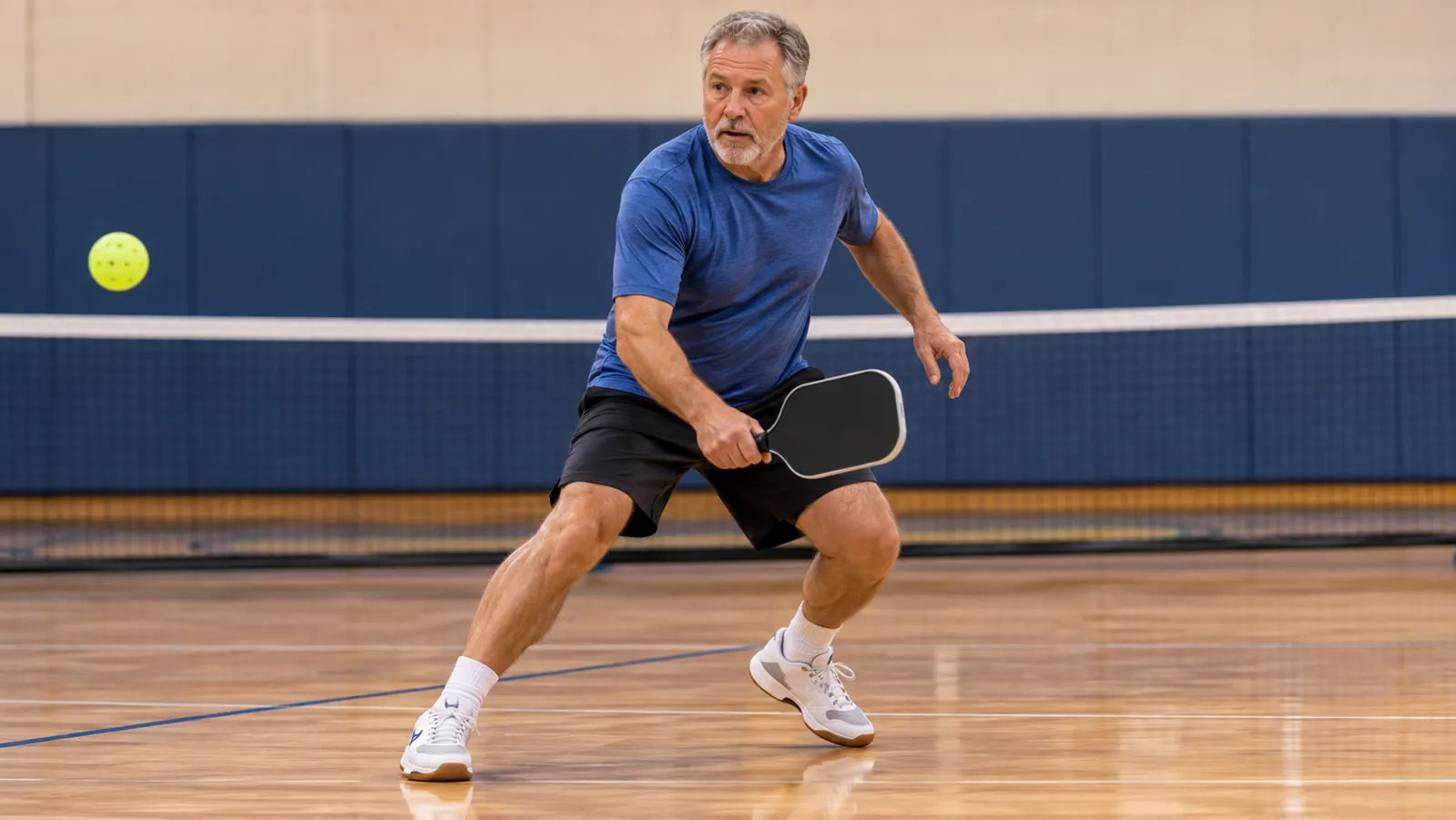
Strip away the packaging and it is a lace-up athletic shoe with cushioning, built for court sports. The listing names pickleball, tennis and racquetball, and describes the shoe as breathable, cushioned, flexible and lightweight. My job here is not to sell you a materials breakdown, because I do not know what half of that means in a lab. My job is to tell you that all four of those words turned out to be true in the ways that mattered to me, and none of them turned out to be true in a way that would make me exaggerate.
The part that actually changed my game is the outsole, and I am not going to name a rubber compound because I do not know it. What I know is that on the wooden gym floor where I wiped out, the sole grabs. I stop when I want to stop. I push off to my right without that half second of float where you can feel the floor leaving without you. If you have played indoors in running shoes, you know exactly the feeling I am describing. You also know it is worth fixing.
The upper is where the breathable part earns its keep. Knoxville in July is not a dry heat, and the gym is not air conditioned to my taste. My old running shoes turned into a swamp by the second game. These do not. It sounds like a small thing until you have spent three games thinking about your feet instead of the score.
Grip Is the Whole Story
Everything else about a court shoe is negotiable. Grip is not. I learned that in one slide. The first Monday I played in these, I went out wide for a forehand, felt the shoe hold, and actually laughed. Not because it was a great shot. It was not, I popped it up and Phil put it away. I laughed because for the first time in a year my feet were doing what I told them.
Here is the thing about grip, though. It is not a superpower. It is a floor. Once you have it, you stop thinking about it. I have not thought about slipping since May, and that is the highest compliment I can pay a piece of equipment. There is no moment in a game where I think about the Viper Court Smash. There is only a long run of Mondays where I have not gone down.
The outdoor courts taught me something I did not expect. Ours are painted and they hold a little dew until about eight in the morning, so the first two or three games on a Monday can be slicker than a gym floor ever is. In running shoes I used to shorten my steps on those mornings without realizing I was doing it, which meant I was playing a different, worse game until about nine o'clock. Now I play the same way at eight that I play at ten. I also noticed the tread holds the loose grit on the court surface instead of letting me skate over it, and that the sole is not so soft that it folds over when I plant. Two months in, the pattern under the ball of my foot is worn flat in the same place on both shoes, which tells me the shoe is doing its job and also that I am not moving as well as I think I am.
The first Monday I played in these, I went out wide for a forehand, felt the shoe hold, and actually laughed. For the first time in a year my feet were doing what I told them.
Indoors, Outdoors, and the Cushion Question
I wear the same pair indoors and outdoors. That is not good shoe management, and if you keep a separate court bag and gym bag, buy two pairs and be smarter than me. But I am not that organized, and one pair has handled both. On the outdoor courts, which are painted over a surface harder than it looks, the cushioning is the reason I can play Friday and still take the stairs normally on Saturday.
Cushioning is also where court shoes go wrong in the other direction. Too soft and you feel like you are standing in sand, which is worse for moving sideways than a firm shoe. The Skechers pair lands in the middle for me. Firm enough that I am not wobbling, soft enough that my heels are not filing complaints by Thursday. They also bend where my foot bends, which sounds like nothing until you have spent three hours in a stiff shoe and felt your arch start to argue.
There was a Friday in July that settled the cushion question for me. It was 88 degrees by nine in the morning, we played five games in a row because a group from a church league took over one court and left us short, and by the fifth game I was standing flat-footed between points with my hands on my knees. My legs were done, but my heels were fine. Same thing the next morning. That is the trade I wanted. Not a shoe that makes me fresher, a shoe that stops me paying for the session two days later. And the lightness matters more than I expected. My old running shoes were heavier, and by the third game I used to feel the weight of them in my calves. These I do not notice at all, which is exactly what I want from a shoe.
If you have plantar issues or you wear a firm orthotic, that is a conversation for your foot doctor and not for a retired UPS driver on the internet. I can tell you how they felt on my feet. I cannot tell you how they will feel on yours.
What I Noticed After Two Months
Here is the honest part. These are court shoes. They are built for a floor, and I have worn them out to the car and across a gravel lot, and I can feel the sole picking up grit. If you plan to walk the dog in them, you are going to wear down the part that does the actual work. That is true of every court shoe and it is not a knock on this one, but it is a good reason to keep a separate pair for errands.
The upper took a few sessions to loosen across the top of my foot. Not painful, just present, the way a new pair of work boots is present for the first week. That went away and never came back. I have played in them since with no hot spots and no blisters, and I am not a person who tapes his feet before a rec center game.
Two details worth passing along. First, the laces. They are ordinary laces, and mine started coming untied about once every other session until I double-knotted them and stopped thinking about it. Small thing, easy fix, but I fought it for three weeks. Second, once they hit about forty sessions the inside heel lining started showing a soft spot on my right shoe, the one I drag on my backhand side. That is me, not the shoe. I have dragged that foot through every pair of shoes I have owned since 1994, including the boots I wore for a living. If you are a dragger, expect the same and do not blame the product. And the big one, the thing I want to be straight about. These shoes will not fix your elbow, your knee or your hip. My right elbow still aches after a long session and I still wear the strap some days. A shoe is the bottom of you, and the bottom of you matters more than most people admit, but it is not a treatment. If you have joint pain that is getting worse rather than staying the same, talk to your doctor before you talk to a shoe company.
What I Liked
- Real grip on a wooden gym floor, which is the entire reason I bought them
- Cushioned enough that three mornings a week on hard outdoor courts does not leave my heels sore
- Light enough that I forget I am wearing court shoes instead of sneakers
- Breathes in Tennessee summer heat, which my running shoes never did
- One pair covers pickleball, tennis and racquetball, indoors and out
Where It Falls Short
- They are court shoes, so pavement and gravel chew the sole that does the work
- The upper felt stiff across the top of my foot for the first few sessions
- The laces needed a double knot before they stopped working loose mid-game
- They will not help a sore elbow, a bad knee or an aching hip, and nobody should expect them to
- One pair means one pair, so a rainy Monday leaves you in damp shoes on Wednesday
Who This Is For
If you play indoors at all, even one morning a month when it rains, this is an easy call. Gym floors are unforgiving and running shoes on them are a bad bet I made for a year. If you play outdoors three times a week on a hard painted surface and your heels are complaining the next day, these are worth a look for that reason alone. And if you came over from tennis and already own court shoes, these are a fine second pair rather than a necessary upgrade.
Who Should Skip It
If you only play outdoors on a soft, well-kept surface and your current shoes still have real tread on them, you probably will not notice much difference and I would not spend the money. If you have a specific foot problem and you already know the exact shoe that works for you, do not let a review from a 59-year-old in Tennessee talk you out of it. And if you are hoping a shoe will make you faster, no shoe does that. I am living proof, and Phil will confirm it.
If Your Feet Went Out From Under You Once, Fix It
I bought one pair in early May and have not slipped since. Lace-up, cushioned, built for pickleball, tennis and racquetball, and it works on a gym floor and a painted outdoor court alike. Sizes and today's price are on the listing.
Amazon Check Today's Price on Amazon →