
I bought the HEAD Extreme Elite in the middle of March, the first paddle I ever owned that did not come two to a package from a big-box store. By the end of July it had slid from the front pocket of my bag down to the bottom of it. That sounds like the start of a bad review. It is not. It is the most honest thing I can tell you about this paddle, and most write-ups skip it entirely.
Here is the whole thing up front. The HEAD Extreme Elite is a light, thin, fiberglass-faced paddle that gives you more pop than you paid for and asks your hand to supply the control. I played it three mornings a week for about four months before I moved to a heavier paddle. I still carry it. I still hand it to nervous newcomers at open play. And I still think it is a sensible first real paddle for a lot of people standing where I was standing in March. But two things about it surprised me, and one of them cost me three or four weeks of dinks that popped up and got me hit at the kitchen line.
The Quick Verdict
Light, honest and comfortable in the hand. A pop-first paddle that will not cover for a wristy swing, and does not pretend to.
Amazon Check Today's Price →The paddle I hand to every nervous newcomer at open play
If you are stepping up from a starter set and you want something that feels fast in your hand without a big commitment, this is the one I lend out. Mine has taken a season of beginners hitting with it and it is still in the bag.
Amazon Check Today's Price on Amazon →What the HEAD Extreme Elite Actually Is
The listing calls it a fiberglass paddle with a polypropylene honeycomb core and a comfort grip, and the numbers back that up. It measures 16 inches long and 7 7/8 inches wide, which is a standard pickleball footprint, so nothing strange happens to your swing path the first time you pick it up. The core is 11 mm, or 7/16 of an inch, which is on the thin side. The listed weight is 7.8 ounces, 220 grams if you like the metric line on the box. The grip comes in at 4 1/4 inches. The frame is graphite. HEAD lists the skill level as intermediate and includes a one year manufacturer warranty.
Two of those numbers matter more than the rest. The 11 mm core and the 7.8 ounce weight are what make this paddle feel the way it does. Thin core plus light static weight equals a fast, whippy paddle that transfers a lot of energy into the ball. It also equals less material sitting between your hand and an off-center hit. I will get to that, and I will not be gentle about it.
The third number that matters is the grip. A 4 1/4 inch circumference is middle of the road, and on a paddle this light it changes how the thing sits in your fingers. That turned out to be the part I appreciated most, which is not what I expected in March.
How I've Used It
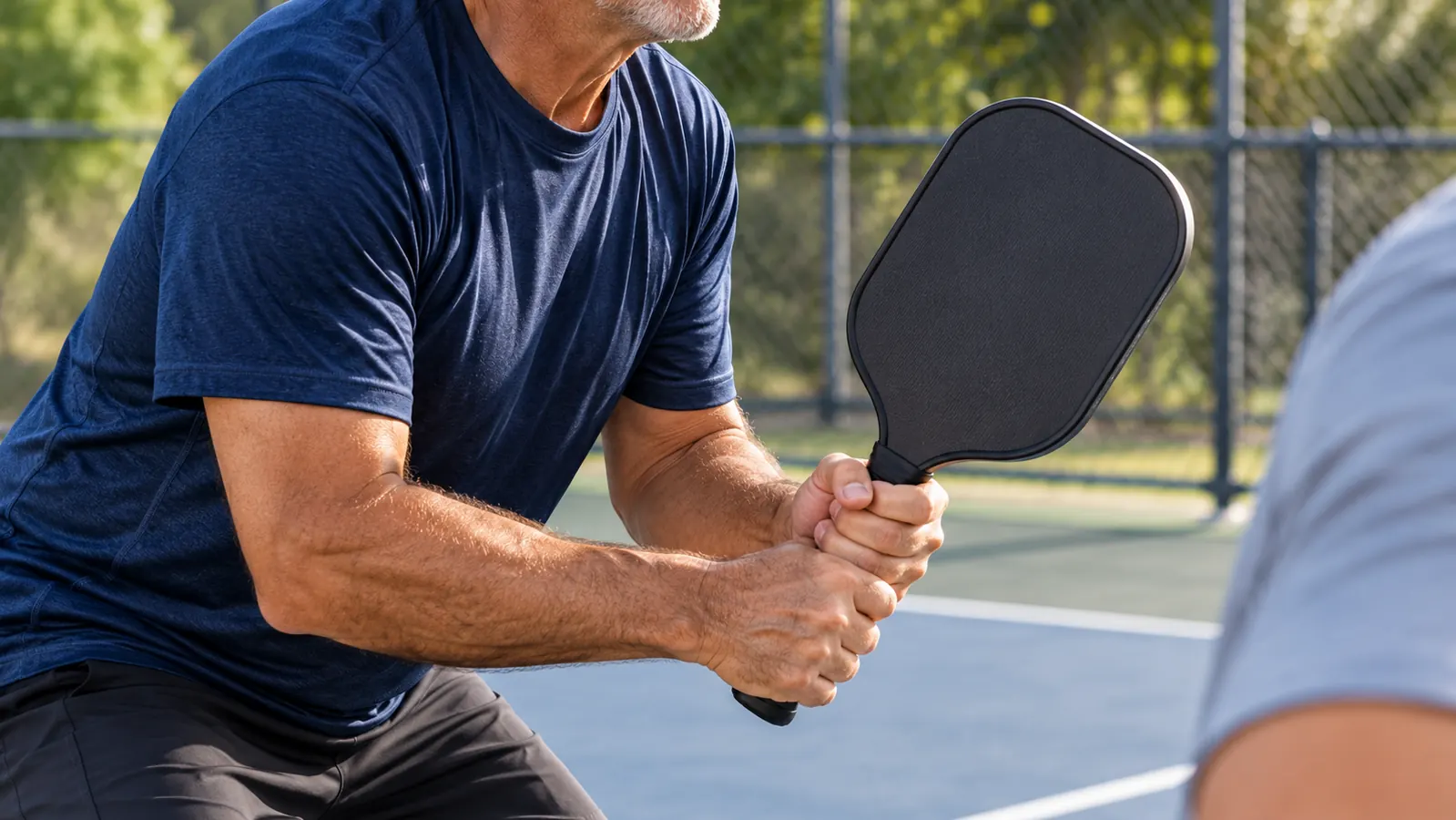
I play doubles three mornings a week at the city rec center here in Knoxville, Monday, Wednesday and Friday, and I am good for about a 3.5 on my own honest self-rating. When it rains, or when the cold gets serious, the whole group moves into the gym on the indoor balls. I play the right side, I am right-handed, and I have a sore right elbow from thirty-one years of lifting packages onto a truck. That is why I pay attention to weight and vibration more than I used to.
The Extreme Elite was my paddle for every one of those sessions from mid March through most of July. Call it four months and fifty or sixty mornings, split between the outdoor courts and the gym floor. My neighbor Phil is the one who dragged me into this game back in the spring of 2024, and he is also the one who told me in my second week of open play that a borrowed starter paddle buzzing in my hand was a sign it was time to buy a real one. So I bought one. This was the one.
Since July it has been the backup. It lives in the bag, and when somebody shows up with nothing, or with something from a garage sale that sounds like a plastic toy when the ball hits it, I hand them this. Roughly a dozen people have hit with it at this point. Nobody has handed it back and told me it felt bad, and a couple of them went and bought their own.
What Nobody Tells You About an 11 mm Core
Here is the part I wish somebody had said to me in March. A thin core is fast, and fast cuts both ways. When I hit a drive from the baseline, the ball comes off this paddle with an energy I did not put there. That felt wonderful for about two weeks. Then I started playing better people who hit softer and lower, and I discovered that the same liveliness helping me from the back of the court was actively hurting me at the net.
A dink is a shot where you are trying to take pace off. You want the ball to drop into the kitchen and die there. The Extreme Elite, being thin and light, wants to add something instead. So you have to consciously decelerate, and if you are a 3.5 player who grips the handle a little tighter under pressure, that deceleration turns into a poke. I popped up a lot of dinks in April and May. More than I want to admit in print. When I moved to a thicker paddle, the same swing produced a quieter ball without me changing much of anything.
The Extreme Elite gave me pop I had not earned. From the baseline that felt like a gift. At the kitchen line it was a bill I had to pay.
That is not a defect in the paddle. It is what the paddle is for. HEAD built a light, lively thing for the intermediate player who is still learning to generate pace and wants help doing it. If that is you, the liveliness is the feature and you should stop reading reviews that call it a flaw. If you already have hands and you are losing points because you cannot keep the ball down, you are shopping for the wrong tool, and no amount of practice with this one changes the physics.
I should say the obvious thing before I go further. I am not a coach and I am not a doctor, and I am not telling anybody that a paddle will or will not bother their elbow. If you have joint pain that shows up when you play, talk with your doctor about it. What I can tell you is what I noticed in my own hand. On center hits the Extreme Elite felt fine, no complaints. On hits near the top edge or out by the frame, I felt a sharpness travel up into my forearm that I did not feel with a thicker paddle. I wore my elbow strap more often in June than I do now.
The Grip Is the Part I Underrated
The Ergo Grip is the quiet reason I keep this paddle around. HEAD lists the grip size at 4 1/4 inches, and the shape has a slight flare that sits into your palm rather than fighting it. I have average sized hands for a man my age, nothing remarkable, and the grip felt right from the first morning. Nothing about it made me squeeze.
That matters more than people who have played for years give it credit for. When the grip is too small you clench. When you clench, your wrist locks and your dinks get punchy. The newcomers I hand this paddle to tend to settle down within a few rallies, and I think the grip is a large part of why.
My one complaint is seasonal. In a gym with no air conditioning in July, the grip surface got slick on me by the third game and I found myself wiping it on my shirt between points. A quick pass with a towel fixed it every time. Not a real problem, just a thing to know if you sweat the way I do.
Where It Fell Short For Me
Weight is the first thing. At 7.8 ounces the Extreme Elite is light enough that a hard drive from a strong player can push it around a little. I noticed it most against a left-handed fellow at the rec center who hits a flat ball that comes at your hip and keeps coming. With my heavier paddle, the mass absorbs some of that. With this one, I had to go meet the ball rather than let the paddle do the work.
Second, the thin core means less margin for error on contact point. The sweet spot is real and it is not enormous. Mis-hit toward the top of the face and the ball goes nowhere useful, usually into the net. That is true of most paddles at this level, but it is more true of a thin one.
Third, and this is the honest one, it is not a paddle I would buy again now that I know what I like. That is not the same as saying it is bad. It is saying it did its job, which was to be the bridge between a starter set and a paddle I chose on purpose six months later.
What I Liked
- Light enough to react fast at the net and easy on the shoulder over three mornings a week
- Genuine pop on drives and serves without swinging any harder than usual
- Comfortable 4 1/4 inch grip that nervous newcomers settle into within a few rallies
- Fiberglass face over a polypropylene honeycomb core with a graphite frame
- One year manufacturer warranty from HEAD
Where It Falls Short
- The 11 mm core is lively, which works against you on dinks and resets
- Some shock travels up the arm on off-center hits
- 7.8 ounces can get pushed around by heavy hitters
- The grip surface gets slick in a hot gym
- Not a control paddle, and it does not pretend to be one
How It Compares to What I Play With Now
I moved to a thicker carbon faced paddle in the summer, and the difference on the soft game was immediate and not subtle. Where the HEAD wanted to add energy, the other one wanted to absorb it. My dinks stopped popping up. My resets from the transition zone started landing. None of that made me a better athlete. It made me a player holding a paddle that matched the shots I was actually trying to hit.
But here is the thing that keeps the HEAD relevant to this conversation. When I hand the other paddle to a beginner, they cannot get the ball to the back of the court. It feels dead to them. When I hand them the Extreme Elite, they are rallying within five minutes and they walk off feeling like they played pickleball instead of surviving it. A paddle that makes a new player want to come back on Wednesday is doing real work.
So the comparison is not which paddle is better in some absolute sense. It is which paddle is better for where you are right now. The HEAD Extreme Elite is a very good answer to one specific question and a mediocre answer to a different one, and the trick is knowing which question you are asking.
Who This Is For
You are somewhere between six months and two years into the game. You came from tennis or racquetball, or you came from nothing, but either way you are past losing every point on the serve and you have started to notice that your equipment feels like a toy. You want something that responds when you swing. You do not want to spend your evenings reading about cores and face materials. And you have no interest in a paddle that punishes you for not being great yet. That is the person the Extreme Elite was built for, and it is the person I hand it to on Friday mornings.
It is also a reasonable fit if you play once a week, or if you are buying a first paddle for a spouse or a friend and you want something that will not feel wrong in their hand on day one. HEAD lists it as intermediate and I think that is fair, though confident beginner is closer to the truth.
Who Should Skip It
If your problem is that the ball keeps floating high and you keep getting attacked at the kitchen line, skip it. You need a paddle with more absorption and less pop, and buying this one because it looks like a step up will not fix your dinks. I say that as a man who tried exactly that for two months.
Skip it if you play against heavy hitters and you find your paddle getting pushed around. At 7.8 ounces it is not going to feel stable against a hard flat ball, and technique does not fully compensate for that in a rec game where you have a half second to react. And if you already have joint pain in your elbow, wrist or shoulder, talk with your doctor before you buy any paddle, including this one. What I noticed in my own hand is not medical advice for yours.
One more thing. If you are the kind of player who wants to buy once and keep the same paddle for five years while your game grows, this may not be the last paddle you buy. It was not mine. That is fine, as long as you know it going in and you are not disappointed when your game outgrows it.
The paddle I would still buy for a beginner tomorrow
Four months of rec center doubles and a dozen beginners later, the verdict has not changed. If you need a first real paddle that gives you room to learn, this is the one I keep handing people. If you already have hands, buy the control paddle instead and thank me later.
Amazon Check Today's Price on Amazon →