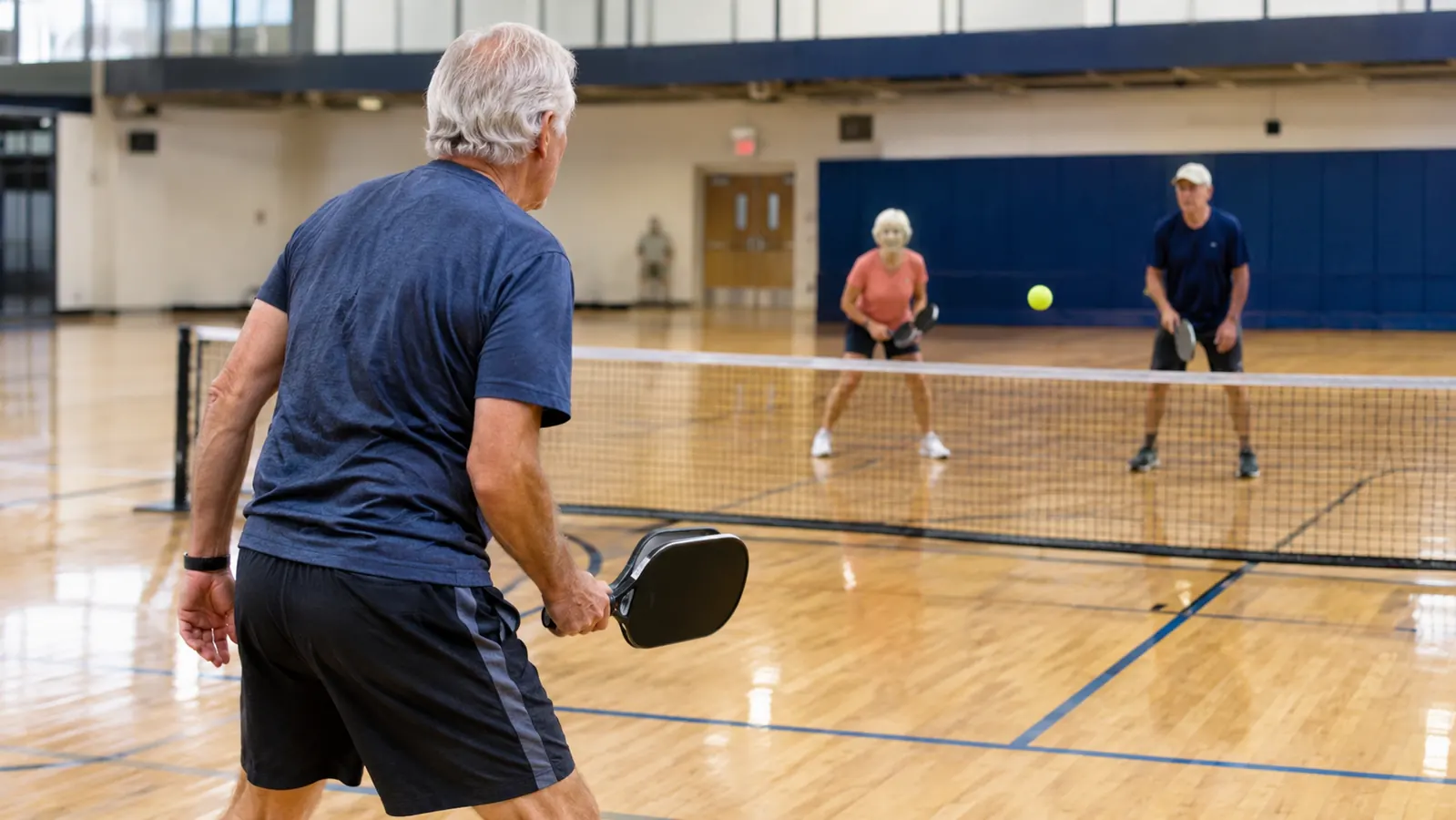
I spent my first month of pickleball playing in a pair of running shoes I had worn through two marathons of walking the dog. They were comfortable. They were also the reason I nearly went down on a wet gym floor in early May, going for a drop shot that I had no business going for.
That slide taught me something the hard way: pickleball is not running, and it is not tennis either. It is short bursts sideways, quick stops, a lot of time on the balls of your feet, and a couple of hard plants per point where your shoe has to hold an edge or you go skating. The shoe that keeps you comfortable walking a greenway is not built for that. Here is how I sorted it out, step by step, and why I ended up with the Skechers Viper Court Smash as the one pair I use indoors and out.
One pair that handles the gym floor and the outdoor concrete
I did not want two pairs of shoes in the back of the CR-V. The Skechers Viper Court Smash is what I wear for both, three mornings a week.
Amazon Check Today's Price on Amazon →Step 1: Figure Out What Surface You Actually Play On Most
Before you look at a single shoe, count your sessions. I play Monday, Wednesday and Friday outdoors at the city rec center, and indoors in the gym when it rains or when the temperature drops. That is roughly two outdoor mornings to one indoor morning in a normal month, more indoor in the winter. Do that count on a calendar instead of in your head. If you had asked me in April, I would have sworn I played indoors most of the time. Then I actually marked the mornings with a pencil in the kitchen, eleven outdoor and four indoor, and I was wrong by a mile. It changed which shoe I should have been shopping for.
Why does the count matter? Because the two surfaces want different things. An outdoor court is textured concrete or a sport surface. It grips hard and it grinds the bottom of your shoe down. Indoors you are on polished wood or a synthetic gym floor, which is slick when it is clean and slicker when somebody tracks in moisture from the parking lot. I check the floor now before the first game. If the side door has been propped open and it is drizzling out, the first eight feet inside that door are greasy, and I start further back until it dries off.
If you are 90 percent outdoor, lean toward a shoe built for abrasion. If you are 90 percent indoor, you want something that will not slide. If you are like me and it is a mix, you want a court shoe that is honest about both, and you want to accept that it will be a compromise. There is no shoe that is perfect on both. There is only a shoe that is not dangerous on either.
Step 2: Stop Wearing Running Shoes, and Understand Why
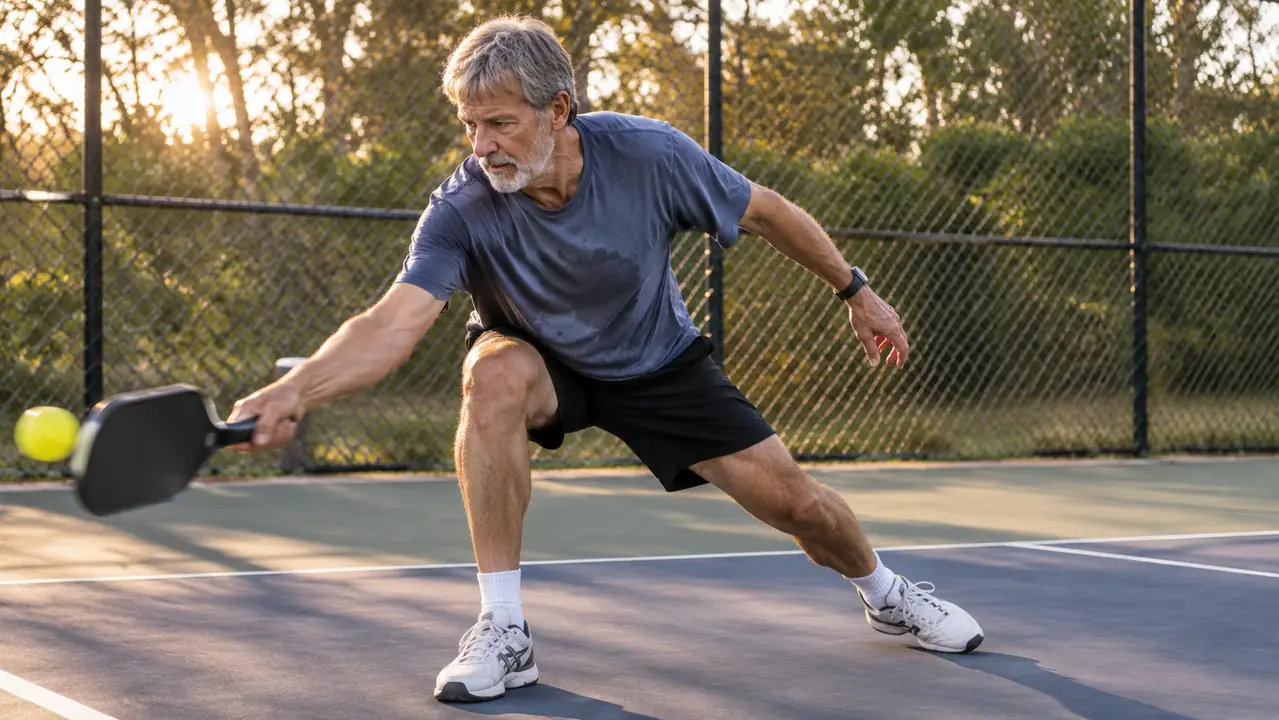
Running shoes are built to go forward. The sole is thick and the heel is high, which is fine when your stride is straight ahead and your foot lands heel first. On a pickleball court your foot lands sideways, or on the toe, or on the inside edge, and a thick soft sole rolls under you. Here is the exact play, since I have thought about it more than I should have. I went back for a drop shot near the kitchen line on a rainy Monday morning in early May, planted my left foot to change direction, and the sole kept going. My foot slid a good six inches, my knee bent a way I did not care for, and I caught myself with my hand flat on the floor. I did not fall. That was luck, not footwear.
The tread is the other half of it. Running shoe tread is designed for pavement and dirt. I flipped mine over that night and looked at the bottom. The middle was nearly smooth from two years of greenway walking, and the little blocks that were left were hard plastic with no edge on them. On a gym floor that is basically a pair of skates. On an outdoor sport court it grabs plenty, which sounds good until you try to stop and your foot keeps going while your knee does not.
A court shoe sits lower to the ground and it is built for lateral movement. That is the whole difference. You feel the floor through it, which sounds uncomfortable and is actually the point. I noticed the difference the first morning. My feet were talking to me more, and my knees were talking to me less.
Step 3: Get Fit Right, Because Court Shoes Are Not Sized Like Sneakers
This is where people get burned. Court shoes are often cut narrower than a general athletic shoe, and the toe box can be tighter. Order one pair in your normal size, not three sizes to sort out later, and pay attention to two things when they arrive: whether your toes can move at all, and whether your heel lifts when you push off. Ten minutes in the living room saves you a returned package and a sore morning.
Toes need a little room, not a lot. In a court shoe, your foot slides forward when you stop hard. If your toe is already touching the front of the shoe while you are standing still, you will feel it every time you lunge. Heel lift is the other one. If your heel comes up out of the shoe when you walk around the house, the shoe is either too long or not laced right, and on a court it will cost you stability.
Wear the socks you actually play in when you try them on, and do it in the evening. I wear a cushioned crew sock, and that is a half size difference from the thin socks I run errands in. Feet swell during the day. By the third game of a morning mine are wider than they were at 7 a.m., and if I had tried a shoe on at dawn in dress socks I would have bought the wrong size. The other thing I did, and it sounds silly, is measure my foot. I put my heel against the inside of an open shoebox lid, marked the tip of my longest toe with a pencil, and measured it against a tape. Now I know my own number and I have stopped guessing at it.
Step 4: Check the Three Things That Actually Matter on Court
Forget the marketing language. When I put a shoe on now, I check three things, in this order.
One, cushioning under the ball of the foot. That is where you live in pickleball. My heels are fine, it is the front of my foot that takes the beating. I press my thumb into the forefoot and see how much give there is, then I stand on it and shift my weight forward. Two, how flexible the shoe is through the middle. I hold it at the heel and the toe and push the two ends toward each other. If it fights me the whole way, my foot will fight it too on a lunge. Three, weight. A heavy shoe makes the third game feel like the fifth, and I can tell the difference standing in my kitchen before I ever get to a court.
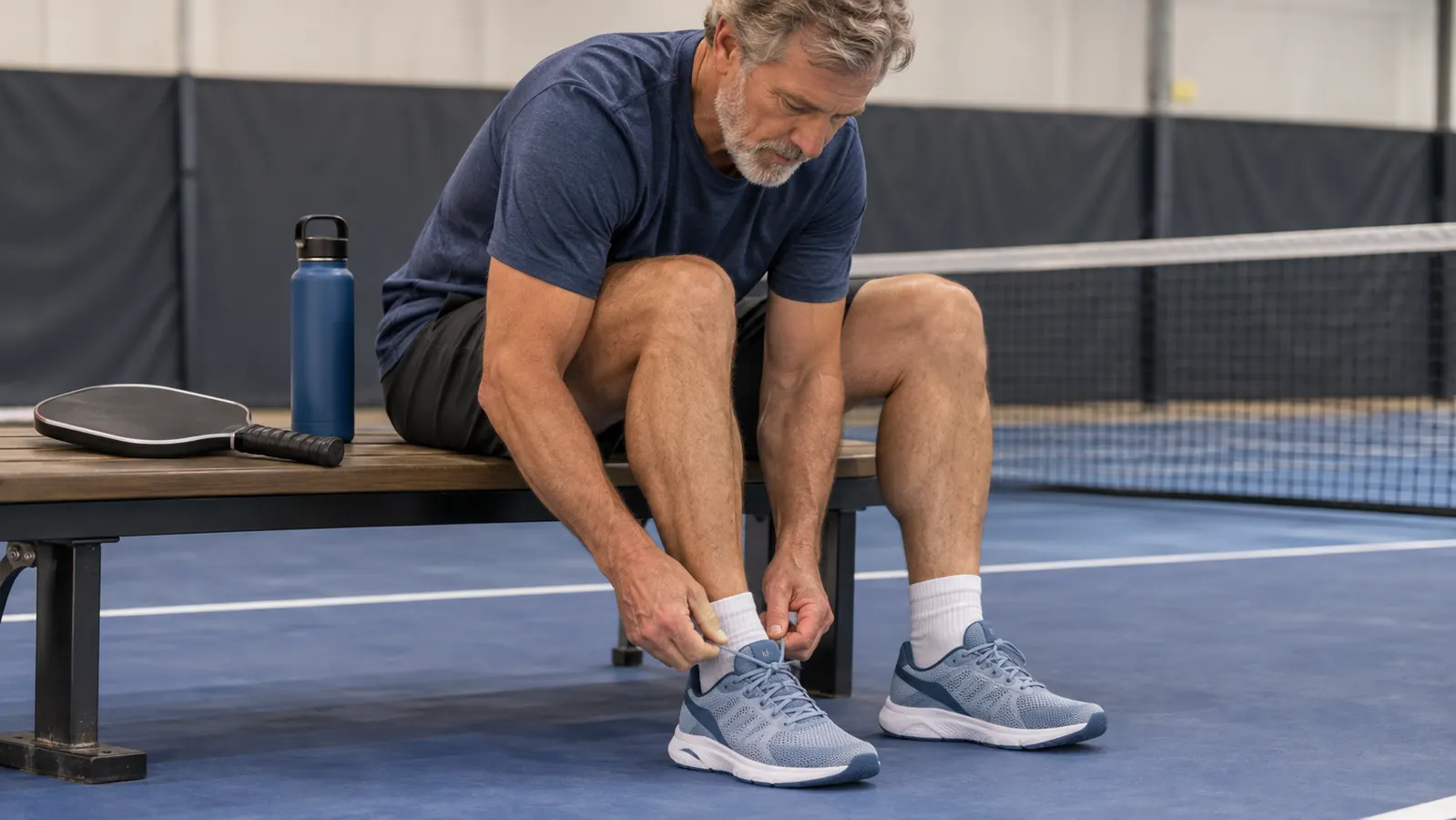
The Skechers Viper Court Smash hits all three for me. It is listed as cushioned, flexible, lightweight and breathable, and that matches what I feel. It is a lace-up with a plain toe, and it is rated for pickleball, tennis and racquetball, which tells you the sole was built for court movement rather than a jogging path. Notice what I am not telling you. I am not going to quote you a millimeter of drop or the name of a foam. I do not know those numbers and they would not help you anyway. What I know is how my feet felt at the end of a session.
Running shoes are built to go forward. Pickleball sends you sideways, and the shoe has to survive that or you do not.
Step 5: Test Them Slowly Before You Trust Them
Do not take a new pair straight into a hard three-game morning. Here is the schedule I use now, and it has not failed me yet. Tuesday evening, around the house for two hours, making supper and doing the dishes, socks on. Wednesday morning, one session at maybe seventy percent effort, and I stay out of the fast games on the end court. Friday, a normal morning. That is three days of easy does it before I trust a shoe to hold me on a hard stop. I made the mistake of skipping all that once, years ago, with a different pair of shoes, and spent two days walking like a man twice my age.
Pay attention to two spots during that Wednesday session: the outside edge of your little toe, and the back of your heel. Those are where a bad fit shows up first. I check at the end of the morning rather than the start, because a rub that is nothing at 8 a.m. is a blister by 9:30.
After the Friday session, decide. If your feet are sore in a general, tired way, that is normal and it fades in a week or two. If you have a hot spot or a rub in one specific place, the shoe does not fit you, and no amount of breaking in will fix it. Return it and size up, or try a different shape entirely.
What Else Helps
Three smaller things made a difference for me beyond the shoe itself.
First, keep your court shoes for the court. I was wearing mine out to the car and into the grocery store afterward for a couple of weeks, and the grit I tracked in from the parking lot is exactly what made the gym floor feel greasy the next time. Now I change at the rec center, the shoes go in the bag, and my walking shoes go back on for the drive home. It takes ninety seconds and it keeps the sole clean.
Second, if you have a sore elbow or a cranky knee, deal with that separately. I have had a sore right elbow since my years on the truck, and a shoe did not fix it, because a shoe is not going to fix an elbow. I wear a basic strap some days and I mention it at my yearly. If joint pain is the reason you are shopping for shoes, talk to someone with a medical degree, not a guy who drives a silver CR-V to the rec center.
And do not overlook the socks. A thin dress sock in a cushioned court shoe is a waste of a good shoe. A decent cushioned crew sock is the cheapest upgrade in the bag, and it is the first thing I would spend a little money on before I ever considered a second pair of shoes.
Who This Approach Is For
If you play a few mornings a week at a park or a rec center, you are exactly who I wrote this for. You do not need a pro-level shoe and you probably do not need two pairs taking up space in the hall closet. You need one pair that grips on the floor you actually play on, fits your foot without rubbing, and does not leave you limping to the car.
That is where the Skechers Viper Court Smash landed for me. It is not a magic shoe. It is a court shoe that does what a court shoe is supposed to do, and it stopped the sliding my running shoes were causing on the gym floor. My game did not jump a level. My confidence going after a wide ball did go up, because I stopped thinking about my feet halfway through a point.
If you are brand new and still deciding whether you will stick with the game, a cheap pair of court shoes from a big-box store is a fine place to start. Do not spend a lot before you know you love it. But do not play in running shoes either. That is the one thing I would change about how I started, and I would change it on day one.
The pair I lace up Monday, Wednesday and Friday, indoors or out
One pair, both surfaces, three mornings a week since early May. If your running shoes are sliding on the gym floor, this is where I would start.
Amazon Check Today's Price on Amazon →