There is a particular kind of embarrassment that comes from holding up four people on a pickleball court because you cannot find a water bottle. I did that in late May, on a Tuesday morning, in the parking lot of the city rec center here in Knoxville. Three people stood at the net waiting on me while I leaned into the back of my CR-V and moved a jumper cable, a grocery tote, and a folding chair around, hunting for the sleeve of Franklin X-40 balls that had rolled under the passenger seat. I found them. It took four minutes. It felt like twenty.
The gym duffel I had been carrying since I started playing in the spring of 2024 was fine for a change of clothes and a towel. It was not built for two paddles, a sleeve of balls, a water bottle, an elbow strap, sunglasses, my keys, and a phone charger all at once. Everything sank into one pile at the bottom and stayed there. That is the whole reason I went looking at pickleball bags, and it is why I bought the Mangrove pickleball bag in early June. I have carried it to three mornings a week of doubles since, plus the indoor gym when it rains or turns cold.
The Quick Verdict
Bigger than most bags on a rec center fence, with a hook that earns its keep and five pockets that end the daily dig. The strap is fine, not great.
Amazon Check Today's Price →The bag that ended the parking lot search
Polyester, water resistant, 19.3 inches tall, five zippered pockets, padded back, and a fence hook that keeps it off the wet concrete. Two paddles, balls, a towel, and a bottle with room left over.
Amazon Check Today's Price on Amazon →How I've Used It
My routine is the same three mornings a week. I pull into the lot around 8:40, park under the same maple, and walk in with one bag instead of three things. Inside it on a normal Monday: the Vatic Pro Prism, which has been my main paddle since April, the HEAD Extreme Elite as a backup, a three-pack of Franklin X-40 balls, a hand towel, a 32-ounce water bottle, my elbow strap, sunglasses, and my car keys in the smallest zip pocket.
At the court, the bag goes on the fence by the hook and stays there the whole session. I am not carrying it around. It hangs while I take out a paddle and balls, and it hangs while I put them back. At the end I unclip it, and it rides in the back of the CR-V until the next time. That is the entire relationship. There is nothing complicated about it.
The first week I kept noticing the size. The listed dimensions are 15 inches long, 7.7 inches wide, and 19.3 inches tall, which is taller than the duffel I had been using and noticeably taller than the sling bags a few of the younger players carry. Mangrove says the bag runs 10 to 20 percent larger than a typical pickleball bag, and set next to Phil's old bag it looks like the bigger brother. From what I see on our courts, that claim holds.
What I did not expect is that the extra height is the part I actually use. A taller bag means the bottle stands up instead of lying down and sweating onto a towel. It means the paddles sit with the handles up, so I can grab one without unpacking everything. It means there is dead space at the bottom that I mostly leave alone, because filling it just makes the bag heavier on the walk in.
Compared with the duffel, the difference is not that it holds more. It is that it holds the same things in a fixed place. The duffel was a sack. This is a bag with slots. That sounds like something off a product page, but it is the entire change I noticed, and it showed up on the first morning.
What the Fence Hook Actually Changes
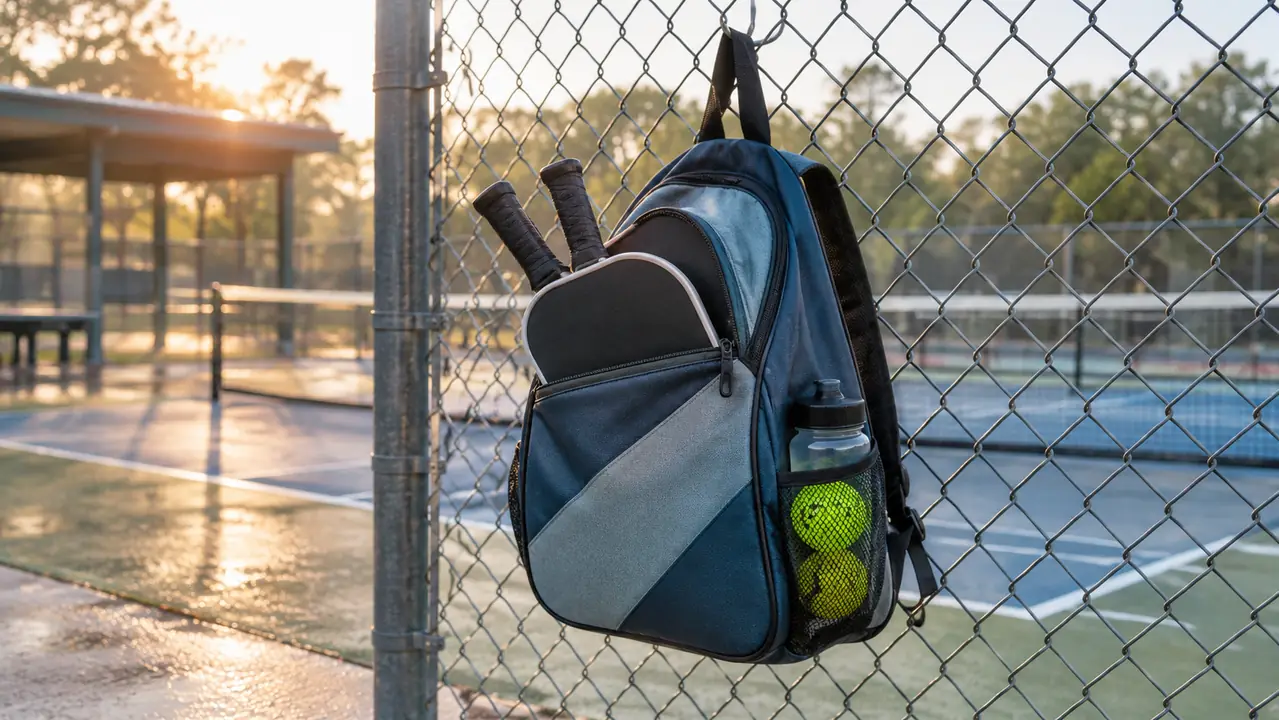
Every bag description mentions a hook. This one is metal, it sits at the top of the bag, and it drops over a chain-link fence without any fiddling. That sounds like a small thing until you play at a rec center where the bench area is two folding tables and a concrete pad.
Before, my duffel went on the ground next to the net post. On a dewy morning the bottom of it came up wet. On a windy morning it collected grit. Once a ball from the next court rolled through and I did not notice until it was mixed in with mine. Hanging the bag keeps it off the concrete and out of the way, and the pockets face me instead of the sky.
The other thing it changes is the pace between games. In a round robin you sit one out and play the next. With the bag on the fence a few steps from the bench, I can pull a dry towel, get a drink, and be at the line when the next game is called. Nobody waits on me to unzip three compartments. The hook does not win games. It removes a small, repeated annoyance, and three mornings a week that adds up to something.
Five Pockets and a Tall Main Compartment
The bag has one large main compartment and five dedicated zippered pockets. That is the arrangement I wanted. Some bags are one big tube, which is exactly how you end up with your keys at the bottom under a wet towel.
My division of labor, if you want to copy it: keys and phone in the smallest zip pocket, the elbow strap and a roll of tape in the next one, balls in their own pocket so they are not loose in the main compartment, and towel and sunglasses in another. The main compartment carries both paddles and the water bottle, which stands upright because the bag is tall enough to let it. Nothing swims around, and nothing has to be unpacked to find anything else.
Five pockets is more than I need, honestly. Two of mine stay empty most weeks. That is not a complaint. Empty pockets weigh nothing, and when Donna comes along on a Saturday she drops her keys and her phone in one and stops handing them to me to hold.
The indoor mornings work differently. In the gym there is no fence, so the bag sits on the floor against the bleachers. Being able to zip every pocket shut means nothing spills when it tips over, which happens about once a month when somebody kicks it while sliding for a ball.
The material is listed as scratch resistant as well as water resistant, and after a few dozen trips across a chain-link fence there are no snags on the front panel. The shell is soft, so the bag flexes when it is loaded and settles against the fence instead of swinging.
Carrying It, and the Parts That Matter Less
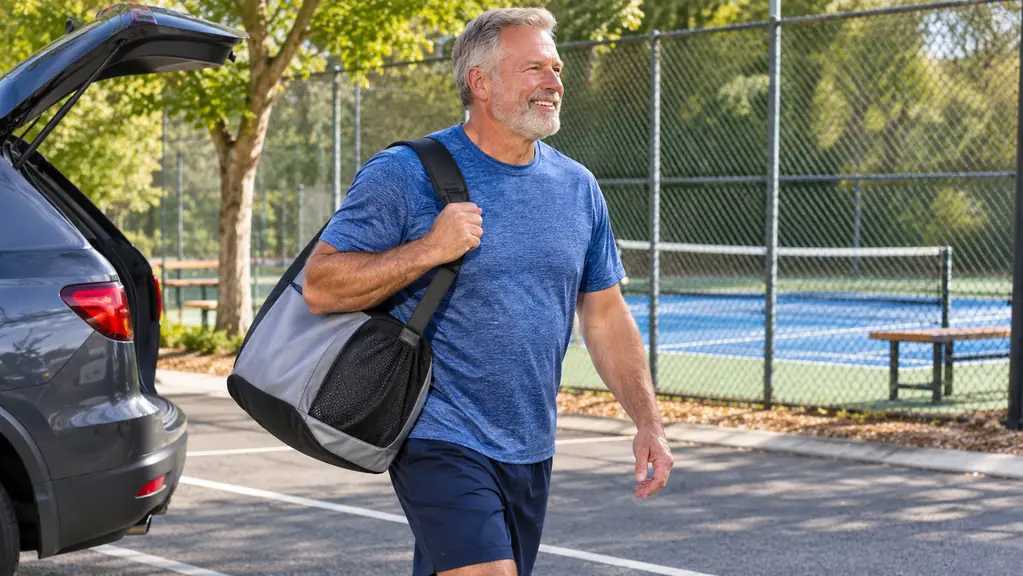
The bag has a padded back panel and an adjustable air-mesh shoulder strap. The walk from the parking lot to the courts is maybe a hundred yards, and I carry it on one shoulder the whole way. The padding on the back matters more than I expected when I am wearing a thin shirt and the bag has two paddles and a full bottle in it.
Here is the honest part. This is not a hiking pack. If you filled it and walked a mile you would feel it. The strap adjusts and the mesh does not get slippery on a hot morning, but the bag holds its shape from padding, not from a frame. For a parking lot walk it is more than enough. For a tournament where you are hauling everything around all day, I would want a wider strap.
The hook does not win games. It removes a small, repeated annoyance, three mornings a week, and that turns out to be worth something.
The shell is polyester and rated water resistant, with a soft shell and zipper closures throughout. I have been caught in a drizzle twice. Both times the outside came in damp and the towel inside stayed dry. I would not set the bag down in a puddle and expect it to hold, and I would not leave it on the fence in a downpour, but for a muggy Tennessee morning water resistant is the right claim and not an inflated one.
The reflective strips on the front are the feature I assumed was decorative. I walk in at 8:40 in the morning, so through the summer I have not needed them. My guess is they earn their place in the winter, when the indoor session lets out after dark and the lot behind the gym is unlit.
The zippers are the part I will watch. They run smooth three months in, and the pulls are big enough to grab with one hand or with a glove on. That is the piece that fails first on a cheap bag, and the bag carries a one-year warranty you handle by messaging the seller, which I have not had to use. If a zipper starts catching, I will come back and say so.
What This Bag Doesn't Fix
It is not a wheeled bag. There are no wheels and no rolling handle. If you have a shoulder or a back that does not like a loaded bag on one side, this is the wrong shape for you and a rolling bag is the right answer. The joint that gives me trouble is my right elbow, not my shoulder, so a shoulder bag works for me. Yours may not, and if joint pain is limiting your play, talk with your doctor before you take advice from a guy at a rec center.
It also does not organize itself. Five pockets only help if you decide what goes where and then stick to it. For the first two weeks I still hunted for my keys because I kept dropping them into the main compartment out of habit. The pockets were there the whole time. I was the problem.
And Mangrove built it bigger than some people want. On a crowded bench a tall bag takes up room. Phil carries one paddle and a bottle and nothing else, and he thinks this is more bag than the game requires. He is not wrong. It is more bag than the game requires. It is about the right amount of bag for what I actually bring.
One more thing worth saying plainly: a bigger bag invites you to bring more. Twice now I have caught myself loading a second towel, a spare shirt, and a paddle I never used. The bag did not do that. I did.
What I Liked
- Fence hook hangs the bag on a chain-link fence and keeps it off wet concrete
- 19.3 inches tall, so a water bottle stands up and paddles sit handles-up
- Five zippered pockets keep keys, balls, tape, and a towel out of one pile
- Water resistant polyester that has handled two drizzles without soaking the towel
- Padded back and adjustable air-mesh strap are comfortable for the walk from the lot
- Reflective strips on the front for dark parking lots
Where It Falls Short
- No wheels and no frame, so it is a one-shoulder carry
- Taller than a sling, which takes up bench space on a crowded court
- The strap is fine for a parking lot walk, not for carrying gear all day
- A bigger bag makes it easy to bring more than you need
Who This Is For
This is for the rec center player who drives to the courts, walks a short distance, and wants one bag that holds two paddles, balls, a bottle, a towel, and the small stuff without turning into a junk drawer. It suits someone who plays a few mornings a week and hangs the bag on the fence rather than carrying it around. If you have been using a gym duffel or a tote and you are tired of digging, the difference shows up on the first morning. It also works for a couple who plays together, because there is room in the main compartment for two people's gear and one person can carry it in.
Who Should Skip It
Skip it if you want a sling or a small bag you can throw over a shoulder and forget. Skip it if you need wheels, or if a loaded bag on one shoulder bothers your neck or back. Skip it if you bring one paddle and one bottle and nothing else, because Mangrove sized this for people who bring more. And if you carry a hard paddle case and want a bag that swallows the case whole, measure the main compartment before you assume, because this one is cut to hold paddles directly.
One bag, one trip from the car
Water resistant polyester, 19.3 inches tall, five zippered pockets, padded back, air-mesh strap, and a fence hook that keeps it off the ground. This is the one I carry three mornings a week.
Amazon Check Today's Price on Amazon →