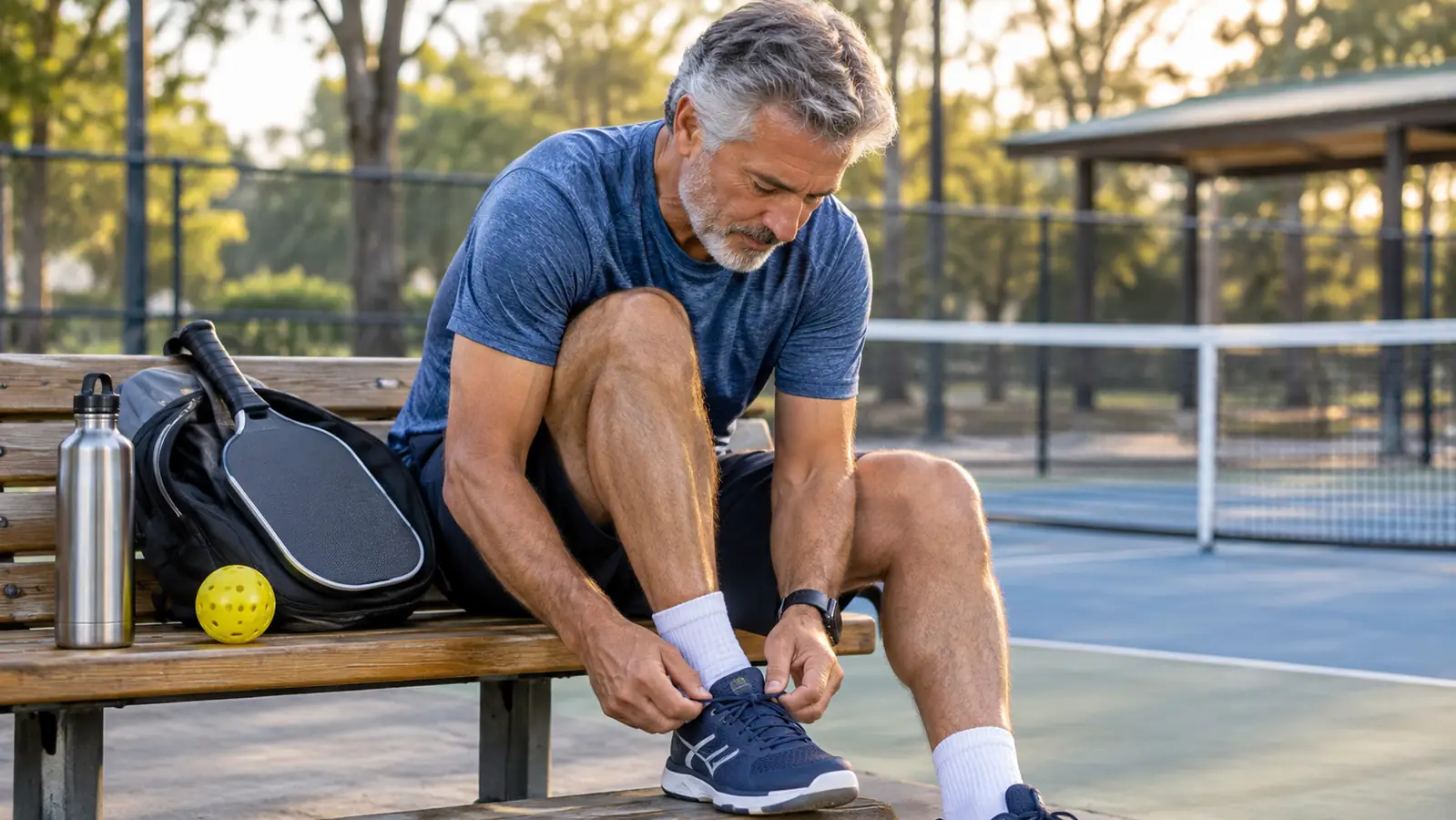
The trouble with shoe reviews is that almost everything feels good in the first week. Fresh cushioning, unbroken laces, no worn-down edges. So I am not going to tell you the Skechers Viper Court Smash felt wonderful on day one and leave it there. I am going to tell you what was still true in August, what was not, and the two things about this shoe that still annoy me every Monday morning.
I bought a pair in early May, the week after a rainy indoor session at the Knoxville rec center. I went for a drop shot, my running shoe kept going without me on that gym floor, and I ended up in a split I am far too old to do. I am 59, I drove a UPS route for 31 years before I retired in 2023, and I play doubles three mornings a week. That slide is the whole reason I went shopping. It is also the fairest thing I can say about the Skechers: it fixed the exact problem I bought it to fix.
The Quick Verdict
A plain, comfortable court shoe that stopped me sliding on an old gym floor. The grip is real, the fit has a catch, and I would buy it again.
Amazon Check Today's Price →If you play indoors on a slick gym floor, this is the pair I would start with
One pair, both surfaces, three mornings a week since May. Check the current listing and the size chart before you order.
Amazon Check Today's Price on Amazon →How I Have Actually Used Them Since May
Three mornings a week, plus a few Saturdays when my wife Donna comes along. Outdoors on the city rec courts when the weather holds, indoors in the gym when it does not. I wear the one pair for both. That is worth saying plainly, because a lot of court shoes are built with one surface in mind and get vague about the other one.
I am a 3.5 level doubles player, right side of the court, right handed. My game is dinking and trying not to hand the ball back at the kitchen line. I am not chasing down lobs in the corner, so I cannot tell you how these behave under a 22 year old's hard lateral cutting. What I can tell you is how they behave over three months of ordinary recreational play, which is what most of us are actually doing out there.
A typical Monday goes like this. I get to the rec center a little before eight, sign in, and pull the Skechers out of the bag. We play three games, sometimes four if the wait list is short, and each game runs about fifteen minutes. So call it an hour of movement, maybe an hour and fifteen if Phil and I get a good rotation going. Then I sit on the bench, take them off, and put my regular shoes back on for the drive home in the CR-V. That is roughly thirty-six sessions since early May, indoors and out. If a shoe were going to fall apart or bruise me, thirty-six sessions is plenty of time to find out.
The first thing I noticed had nothing to do with cushioning. I stopped thinking about my feet on the gym floor. With the running shoes there was a small background hum of worry every indoor session, worse when the floor had any moisture on it. That hum is gone. It is a small thing to pay for and a big thing to live without.
The Grip Question, Answered Honestly
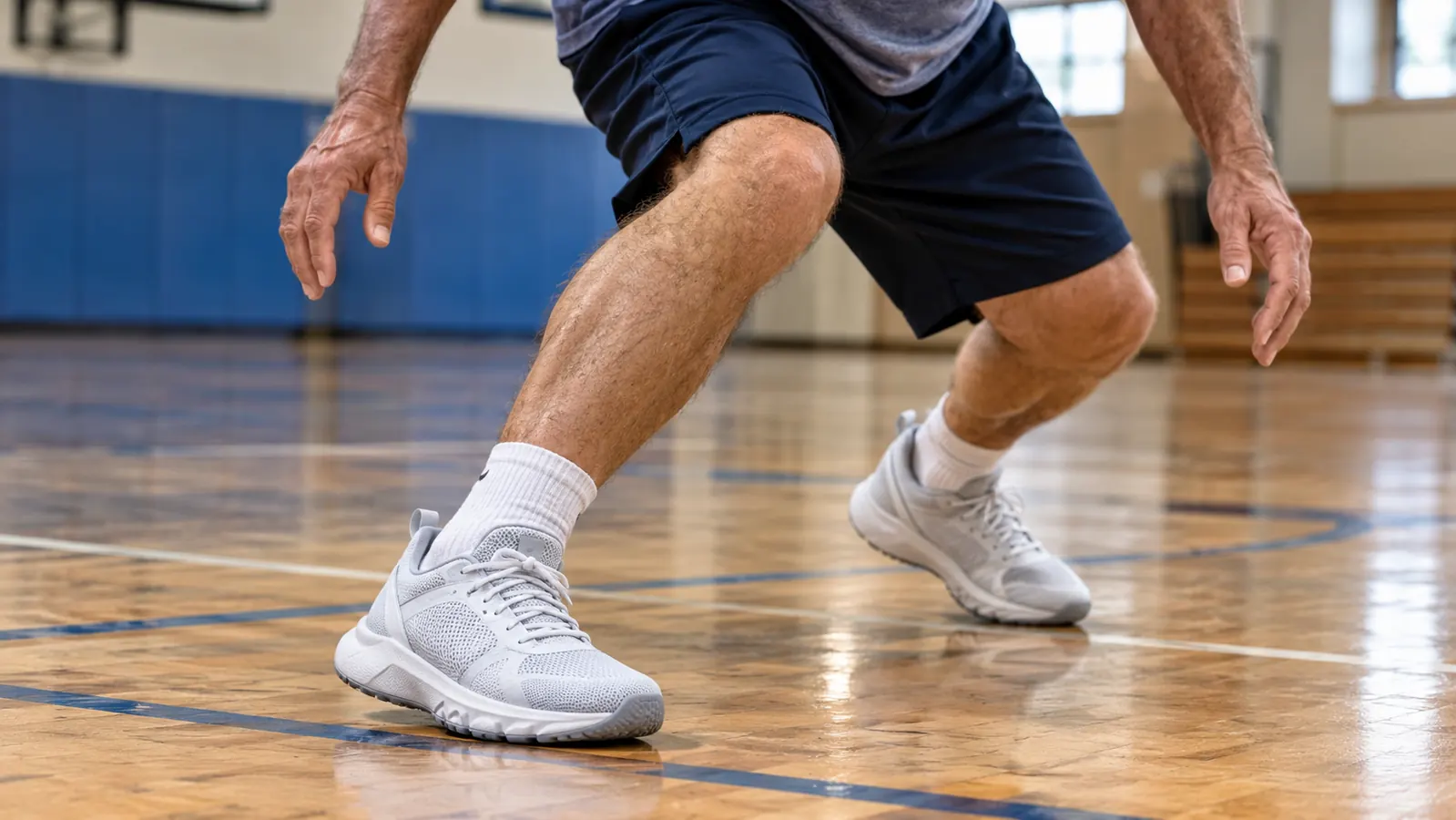
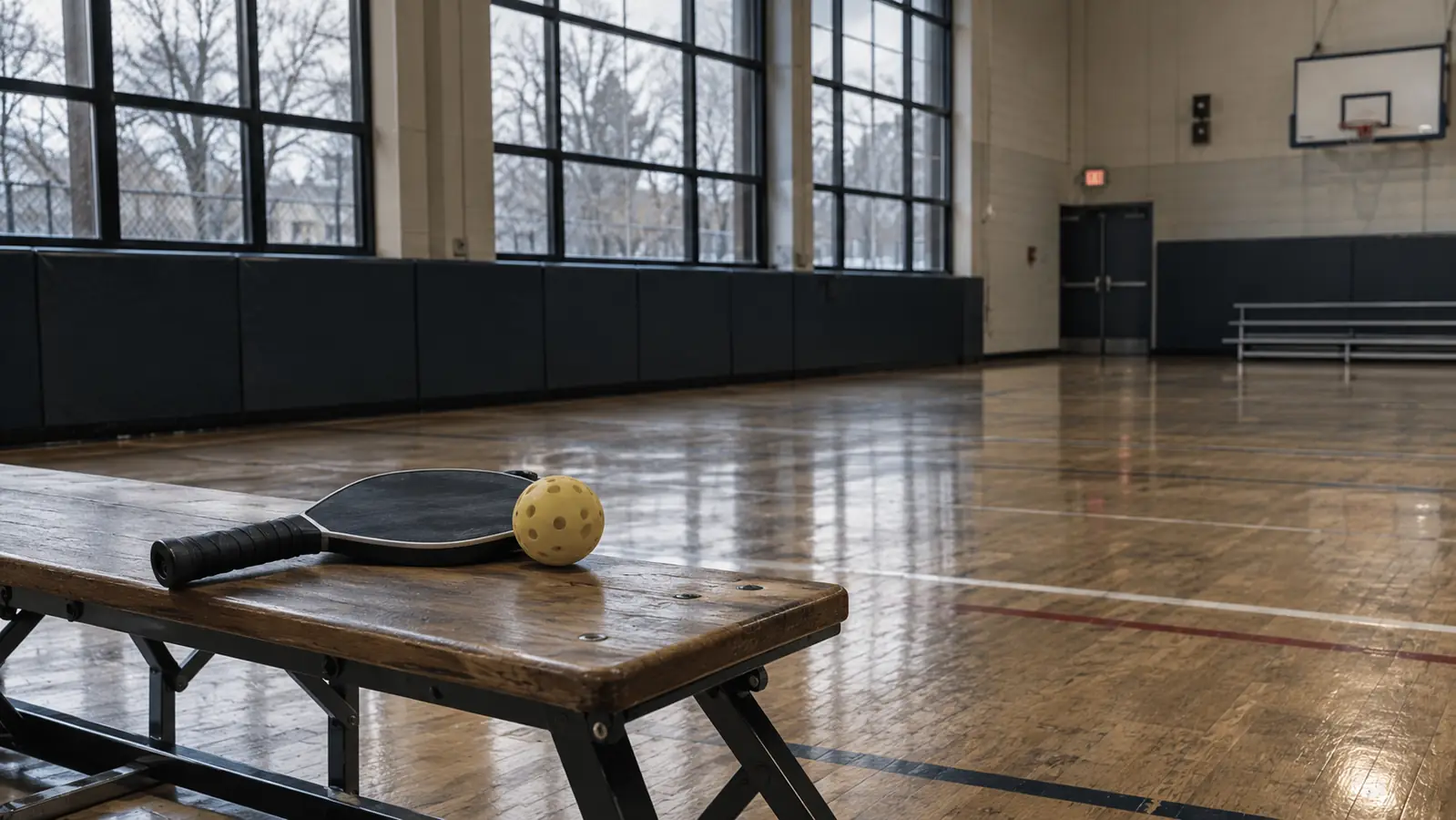
Grip is the thing everybody wants a verdict on, and grip is the thing that depends most on your floor. The rec center gym is old hardwood with a lot of traffic on it, and it gets slick in humid weather. On that surface, these hold. I have not slid once since May. I slid twice in the two months before that, in running shoes, on that same floor.
I can be more specific than that, because I remember both of them. The first was in March, going back for a lob I had no business chasing. The second was the drop shot in May that sent me shopping. Both times my front foot went out from under me and I caught myself on the same hand. Neither was a fall, exactly, but both left me standing there with my heart going and a couple of people asking if I was all right.
Outdoors, on concrete that has been rained on and then baked by the sun, they hold too. I would call the grip closer to adequate than remarkable out there. What I mean is that I am not conscious of the shoe at all on an outdoor court, and being unremarkable is exactly what you want from an outsole. A shoe that calls attention to itself is a shoe that is about to let go.
What I cannot tell you is how they do on a wet outdoor court, because I do not play on one. If it rains, we go inside. If you play on slick outdoor concrete in the damp, that is a question for somebody who does it, not for me.
Fit, Sizing and What Three Months Did to the Shoe
I ordered my normal size and the length is right. There is a little more room in the front than I expected, and my foot is wide from too many years in work boots, so I did not mind it. If your foot is narrow, or you like a shoe that clamps down hard across the top, that room will feel like slop and you will spend the session fussing with your laces. I would think about a half size down in that case.
Here is the part I wish somebody had told me before I ordered. That room is not just about comfort, it changes how the shoe behaves when you stop hard. There is a drill we do at open play, a short ball to the middle that makes you plant and change direction, and the first few times I ran it I could feel my foot slide forward inside the shoe until my toes were right up against the front. It did not hurt. It just felt like the shoe was a half beat behind my foot, and I did not trust it going into a hard stop.
My fix was dumb and it worked. I pulled the laces out of the bottom two eyelets entirely, then re-ran them so the lowest section sits tighter across the top of my foot, leaving the upper eyelets a little looser so the shoe still comes on easy. That took me about five minutes on a bench one Wednesday, and the shoe has not shifted forward since. If you have never relaced a shoe that way, look it up. It is the difference between a pair you like and a pair you stop wearing.
They are a lace up, standard laces, and they stay tied. I mention it because I have owned shoes where they did not, and there is nothing more annoying than stopping mid game to tie a shoe while three people wait on you.
Three months in, the upper has held its shape. No seam has opened up. The inside of the heel collar, which is where I expect a shoe to go first, is starting to look a little polished, but it has not rubbed me raw and it has not started to collapse. I check the insole every couple of weeks when I dump the grit out after an outdoor morning, and it is still sitting flat in the shoe rather than bunched up at the heel. Playing three times a week on hardwood and concrete, I expect to get a full season out of this pair, maybe a little more. I will be honest and say I do not expect two.
Cushioning, Weight and My Right Elbow
I have a sore right elbow from 31 years of lifting packages out of the back of a truck. It flares up when I play too many days in a row, and it is why paddle weight matters to me and why I pay attention to what is under my feet. A pair of shoes that leaves my legs thrashed makes me swing harder to compensate, and swinging harder is the last thing my elbow needs.
The Skechers listing puts the pair at 1.5 pounds and describes them as lightweight, cushioned, flexible and breathable. That matches what my legs tell me. They are not marshmallows. There is a firmness to them that I like on hardwood, and the cushioning shows up more at the end of a session than at the start. After three games my feet are tired, not sore, and that is a difference I can feel.
I tested that on purpose one Wednesday in July. I had played Monday, my elbow was grumbling, and the sensible thing was to stay home. I went anyway, in the Skechers, and told myself I would play two games and quit. I played three. My elbow was no worse than it had been at breakfast, and my feet were fine. I am not saying the shoe did that. I am saying it did not add to the pile, which is more than I can say for the old running shoes on that same floor.
Did they help my elbow? I do not know, and I am not going to pretend a shoe did anything for a tendon. What I can say is that my feet and knees feel less beaten up after a morning of doubles than they did in running shoes, and fresher legs make it easier to keep my arm from doing too much of the work. That is as far as I will go. If you have joint pain, talk to your doctor, not to a shoe review.
I have not slid once since May. I slid twice in the two months before that, in running shoes, on that same floor.
What Three Months on Concrete Did That I Did Not Expect
The outdoor courts at the rec center are not kind. They are old concrete with grit and a few cracks that catch a toe if you are careless. I expected the outsole to be chewed up by July and it was not. The tread is worn, sure, but it is worn evenly, which tells me I am not dragging one edge of the shoe around the court. I have had sneakers that wore a flat spot on the outside of the heel inside two months.
The weather question turned out to matter more than I thought it would. Those outdoor courts get hot enough by nine in the morning in July that you can feel it through the sole, and the shoe has not gotten soft or gummy on me. It also has not stiffened up. I keep them in the back of the CR-V between sessions and they have sat in a hot car for hours and come out the same shape they went in. If you leave gear in the car like I do, that is worth knowing.
The other thing I did not expect was that I would stop noticing them entirely by about week three. That sounds like faint praise. It is not. A good pair of shoes for a recreational player is a pair you forget about, and the Skechers got me there faster than I expected.
The Things That Still Bug Me
Two complaints, and neither is a deal breaker, but you should hear them before you order. First, that room in the front means that on a hard stop I can feel my foot shift forward inside the shoe. I fixed it by relacing the bottom two eyelets a little tighter, and that solved it. But I had to solve it, and I would rather not have.
Second, my feet run warm indoors. The shoe is breathable, and it is more breathable than the running shoes were, but a Knoxville gym in July with no air moving is a Knoxville gym in July with no air moving, and no shoe is fixing that. If your feet sweat a lot, expect to change socks after a long session. I keep a spare pair in the bag for exactly that, and I have used them more than once.
The third thing is about me, not the shoe. Skechers lists these for pickleball, tennis and racquetball, and I believe the listing. But I have only played pickleball in them, so I am not going to vouch for the other two. I would rather tell you what I know than pad out a review with something I guessed at.
What I Liked
- Holds on an old, slightly slick gym floor. I stopped sliding in the first week.
- Comfortable from the first session. No break in period worth mentioning.
- Light enough that three games do not feel like leg day.
- Laces stay tied and the upper has kept its shape through a full summer.
- Outsole wore evenly on concrete rather than chewing up on one edge.
- Sat in a hot car all summer without going soft or stiff.
Where It Falls Short
- Extra room in the front means my foot shifts forward on hard stops unless I relace tighter.
- Feet run warm on a humid indoor morning.
- Grip outdoors is good, not remarkable, and I cannot speak to wet courts.
- Generalist shoe. If you want a specific outsole for a specific surface, this is not that.
Who This Is For
If you are a recreational player who gets out a few mornings a week at a park or a rec center, and you have been playing in running shoes, this is the straightforward upgrade. Especially if you play indoors on a hard floor, which is where running shoes are at their worst and where I did my one and only split.
It also suits a player like me, somebody whose game is dinks and positioning rather than chasing down everything. You do not need a shoe built for a college athlete to play 3.5 doubles on a Tuesday. You need something that holds, fits, and does not leave you thinking about your feet, and after three months the Skechers still does all three.
Who Should Skip It
Skip it if you have a narrow foot or you like a shoe that grips you hard across the top. That extra room in the front will feel loose and you will fight the laces all morning. Skip it if you play on wet outdoor courts, because I cannot tell you how it does there and I am not going to guess.
Skip it if you are a tournament player who wants a different outsole for every surface. This is a generalist shoe and it is honest about that. It does one job well, which is keeping a recreational player upright on a rec center floor, and it does not pretend to be a specialist.
And if what you are really after is a shoe to fix a bad knee or a cranky Achilles, skip all of this and go see somebody who can look at your leg in person. No shoe is doing that job, and anybody who tells you otherwise is selling something.
The pair I would buy again, and I say that knowing the toe box is roomy
One pair, both surfaces, three mornings a week since early May and still holding. Check the size chart before you order, especially if your foot is narrow.
Amazon Check Today's Price on Amazon →