I pack my pickleball bag the night before I play. Not because I'm a planner. Because I've done it the other way, and the other way is a 59-year-old man unloading half a car in the parking lot while three people stand on the court waiting on him. That was me in late May, digging through the back of the CR-V for balls and a water bottle. Elbow strap, no idea where it was. By the time I walked through the gate I had spent five minutes on my feet and had not hit a ball.
So I started packing the way I used to load a UPS truck, and the first thing I did was buy a bag worth packing. The Mangrove pickleball bag is the one I settled on in early June and it is the bag in every step below. The second thing I did was split my gear into two jobs. Indoor and outdoor pickleball are different packing problems that happen to share one bag. Outdoor means Franklin X-40s, a towel, sunblock, and a fence to hang on. Indoor means the gym's own balls, a clean sole on a wooden floor, and nowhere at all to hang anything.
The 19-inch bag that ended my parking lot digging
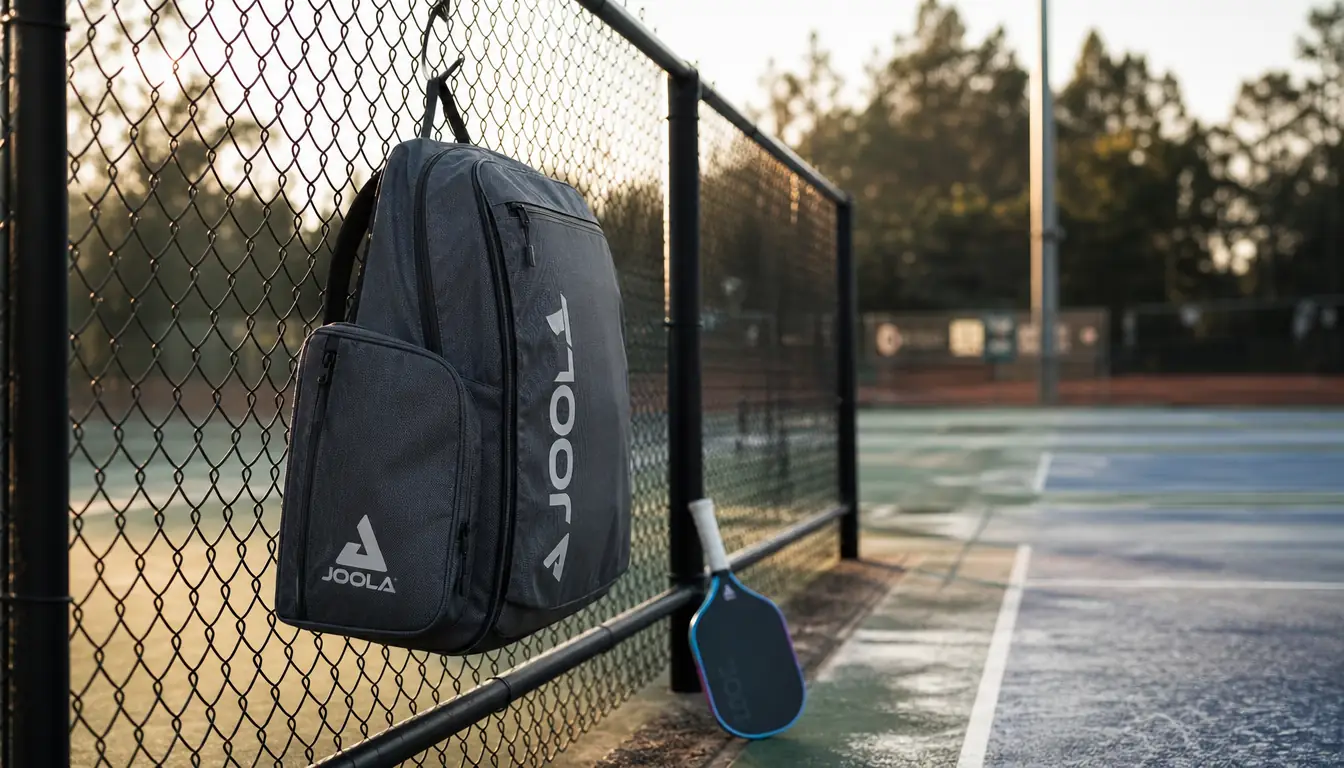
Water resistant polyester, five dedicated pockets, a fence hook, and a padded back with an adjustable mesh strap. I hang mine on the chain link at the rec center and stop thinking about it.
Amazon Check Today's Price on Amazon →Step 1: Start With the Bag Itself, Not the Contents
The Mangrove bag measures 15 inches long, 7.7 inches wide, and 19.3 inches tall. That last number is the one I care about. A pickleball paddle runs roughly 16 inches, so a bag under 17 inches tall forces you to lay paddles flat, and flat paddles migrate to the bottom of the pile and stack under everything else. At 19.3 inches mine stand on their edges and stay put. The shell is polyester, water resistant, soft, and closes with a zipper, with five pockets or compartments in total.
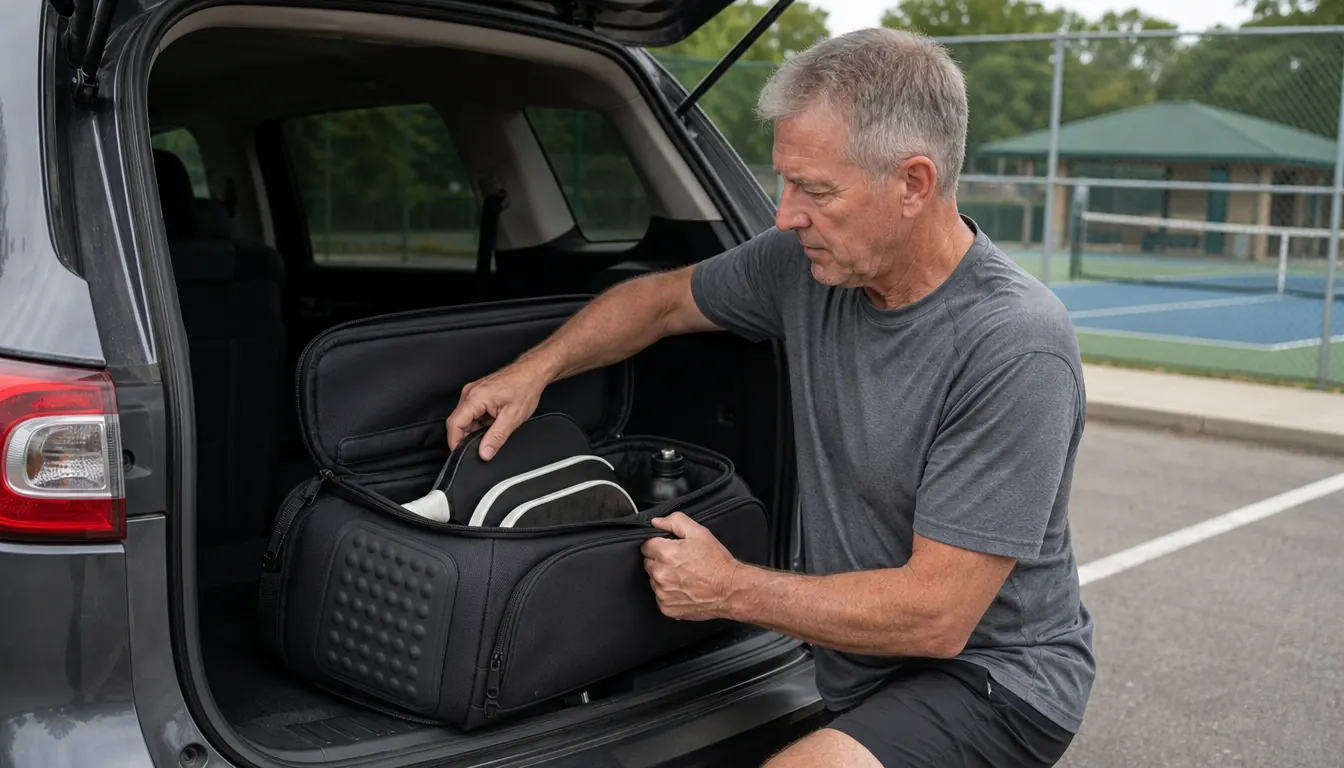
Five pockets sounds like a marketing number until you assign them. I don't use them randomly. Main compartment: paddles, shoes, towel, water bottle. Front pockets: balls, elbow strap. Small zip pocket: car keys. That assignment is the entire system, and it took me one bad morning to settle on it. Nothing about the bag is clever. It's just divided, which is more than my old gym duffel ever managed. I tried sorting gear by memory first. For about three weeks I used that duffel, one big compartment plus a side pocket that had once held deodorant, and I put things wherever I happened to be standing when I unpacked. Then paddle sleeves started turning up in the laundry basket and balls under the passenger seat of the CR-V. The duffel never failed me. I failed it. A bag with one compartment and no assigned pockets asks you to be organized at 8:30 in the morning, and I am not that man. Five assigned pockets ask nothing of you at all, which is why the Mangrove bag works for me.
The fence hook is the piece I didn't know I wanted. At the city rec center the benches sit behind the courts and everybody piles their gear on the same two of them. With the hook, the bag hangs on the chain link next to my court, off the ground, out of whatever puddle is left from the rain the night before. On indoor mornings the hook is useless. That's exactly why the pockets have to do the work instead.
Step 2: Load the Paddles First, Faces Up and Handles Down
Paddles go in first, and they go in with the faces up. My main paddle is a Vatic Pro Prism: carbon fiber face, 16mm thick, foam-injected walls, about 8 ounces, roughly 16.3 by 7.5 inches. It came with a paddle sleeve and the sleeve stays on it inside the bag. Seven months of carrying it this way and the face still comes out clean, which was not true of the starter paddle I had before it.
My backup is a HEAD Extreme Elite, fiberglass face over a polypropylene honeycomb core, about 7.8 ounces, 11mm thick, with a 4 1/4 inch grip. It was my first real paddle back in mid March and now it lives in the bag permanently. It gets its own pocket, separate from the Vatic. Two paddles stacked flat grind against each other, and the edge guard on one chews up the face of the other over a couple of months. The sleeve my Vatic came with does more than keep dust off it. I slide the paddle back into that sleeve the second a game ends, before I walk off the court, while my hands are still on it. A face left sitting against a damp towel for two days is how the surface starts to look tired. For the first couple of weeks I carried it loose in the duffel, and it came out with a scuff along one edge that I still see when I go looking for it.
The backup earns its spot. At open play there is always somebody who showed up with a borrowed paddle or a starter set, and I hand them the HEAD rather than watch a new player get discouraged by a buzzy paddle. A neighbor dragged me into this game in the spring of 2024, so lending one out feels like the least I can do. I'll leave it at that.
Step 3: Build Two Ball Kits, One for Outdoors and One for the Gym
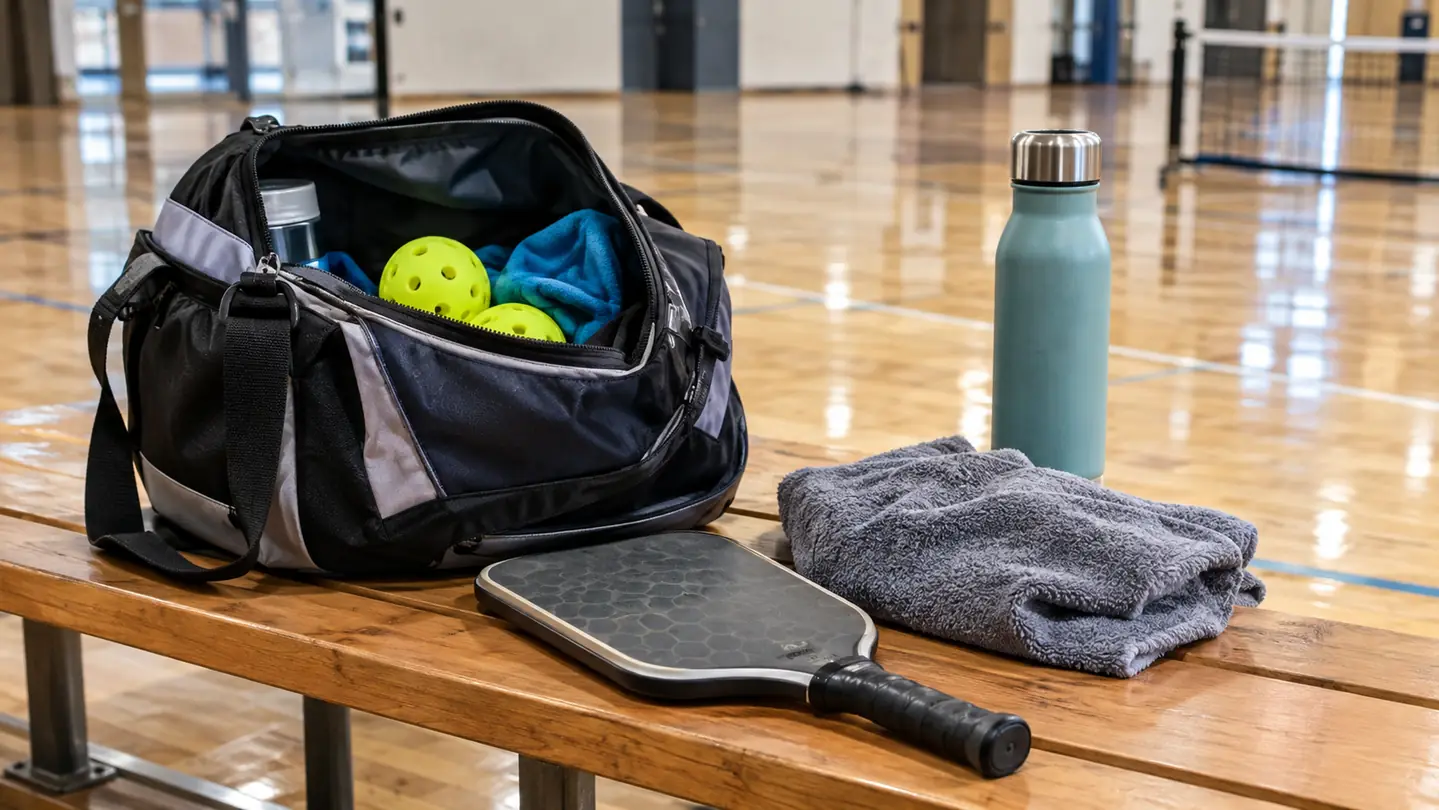
Balls are the thing you will forget, so they get their own pocket and they never come out of the bag. I keep a 3-pack of Franklin X-40s in there. That's the outdoor ball, USA Pickleball approved, 40 drilled holes, hard plastic. They crack, and cold weather speeds that up. A ball that has gone soft plays dead off the paddle, so I check mine every couple of weeks and pull the bad ones.
Indoors I don't pack balls at all. The rec center gym puts out its own indoor balls for open play, and an outdoor ball on a wooden floor skids and bounces low and makes you look worse than you are. If your gym doesn't supply them, carry a separate indoor set in a separate pocket and never mix the two. There is nothing quite as useless as reaching for an outdoor ball on a Tuesday morning and coming up with a slick indoor one.
The rule is one pocket, one job. The front pocket on the right side of my bag is the outdoor ball pocket and nothing else goes in it. That way I'm never sorting balls in a parking lot at 8:45 in the morning with a court full of people waiting. I broke my own rule once, in late August, on a Wednesday, when that pocket held two Franklin X-40s and a smooth indoor ball I had picked up in July and never taken back out. I bounced all three on the concrete before I closed the hatch. A ball that doesn't come back up near waist height off a hard surface is done, and one of them wasn't.
Step 4: Match Your Shoes to the Floor You're Playing On
Shoes are where indoor and outdoor packing actually splits. In early May I played a rainy Monday in the gym in my old running shoes and slid going for a drop shot. Not a fall. Just a skid that put me half a step behind the ball and made me feel about twenty years older than I am. Worn running tread and a polished gym floor are a bad pair, and I knew it before I did it.
I bought one pair of Skechers Viper Court Smash shoes and I wear them for both. Men's lace-up, cushioned, lightweight, made for pickleball and tennis and racquetball. One pair, indoors and out, because I'm not hauling two sets of shoes to the rec center. What changes is the handling. Outdoor mornings they ride in the main compartment and get knocked heel to heel before they go in. Indoor mornings I wipe the soles on the mat at the gym door first.
If your outdoor courts are gravel or crumbling asphalt, do the tap and wipe every single time. Grit that rides home in the bottom of the bag ends up in the paddle edges and the grips eventually. It's a ten second habit that saves you a scuffed paddle face.
Step 5: Put the Small Stuff Where You Can Reach It Without Unpacking
The small stuff is what actually wastes your morning. My elbow strap rides in a front pocket, never the main compartment, because I want it without unpacking anything. I've got a sore right elbow from 31 years of lifting packages, so some days the strap goes on before the first serve and some days it stays in the pocket. It isn't a fix for anything. It's just a habit I've settled into.
Towel in one front pocket. Water bottle standing upright in the main compartment next to the paddles. Car keys in the small zip pocket, and only the small zip pocket. Keys loose in the main compartment is how people end up dumping an entire bag upside down on a bench and then finding one shoe missing. I locked a set in the CR-V once, in a parking lot, on a June morning, and that is the whole reason for the rule. Not a front pocket. Not the water bottle sleeve. Not in my hand, where they get set down on a bench and walked away from. The pocket zips. The zipper is the point.
Two last details that matter more than they sound. The back is padded and the shoulder strap is adjustable and mesh, which you notice on the quarter mile from the far end of the parking lot with a full water bottle in the bag. And the reflective strips across the front are a real thing in December, when the sun isn't up until after we've started. I play Monday, Wednesday, Friday mornings, so I don't think about them most of the year. I'm glad they're there in the winter.
At 19.3 inches tall, the bag lets both paddles stand on their edges, which is the whole reason my paddle faces stopped coming out scratched.
What Else Helps
A checklist. Mine is a 3x5 card in the small pocket that says paddles, balls, shoes, strap, towel, water, keys. Seven lines. I still read it some mornings, and I've been doing this three mornings a week since the spring of 2024. The bag carries a 1-year warranty through the seller, the shell is water resistant and scratch resistant, and in practice that has meant surviving a summer of hanging on chain link and getting thrown in the back of the CR-V.
Two honest complaints about the Mangrove bag. It has no wheels, so a long walk from parking is on your shoulder, and the shell is soft, which is good for stuffing it into a car and bad for standing it up on its own when it's empty. Neither has made me want a different bag. If you play at a place with a real walk from the lot and you have knee trouble, that first one is worth thinking about.
What I stopped carrying matters as much as what I pack. I used to haul a second towel, two water bottles, and a spare paddle I never once used. Now it's one towel, one bottle, two paddles, and the strap. A lighter bag gets checked less often, and a bag you actually check is a bag that's packed right. That's the whole method. Assign the pockets, pack the night before, and know which morning you're packing for.
Hang it on the fence and go play
Five pockets, a fence hook, a padded back, and a water resistant shell, sized so your paddles stand up instead of stacking. It's the bag I've carried three mornings a week since June.
Amazon Check Today's Price on Amazon →