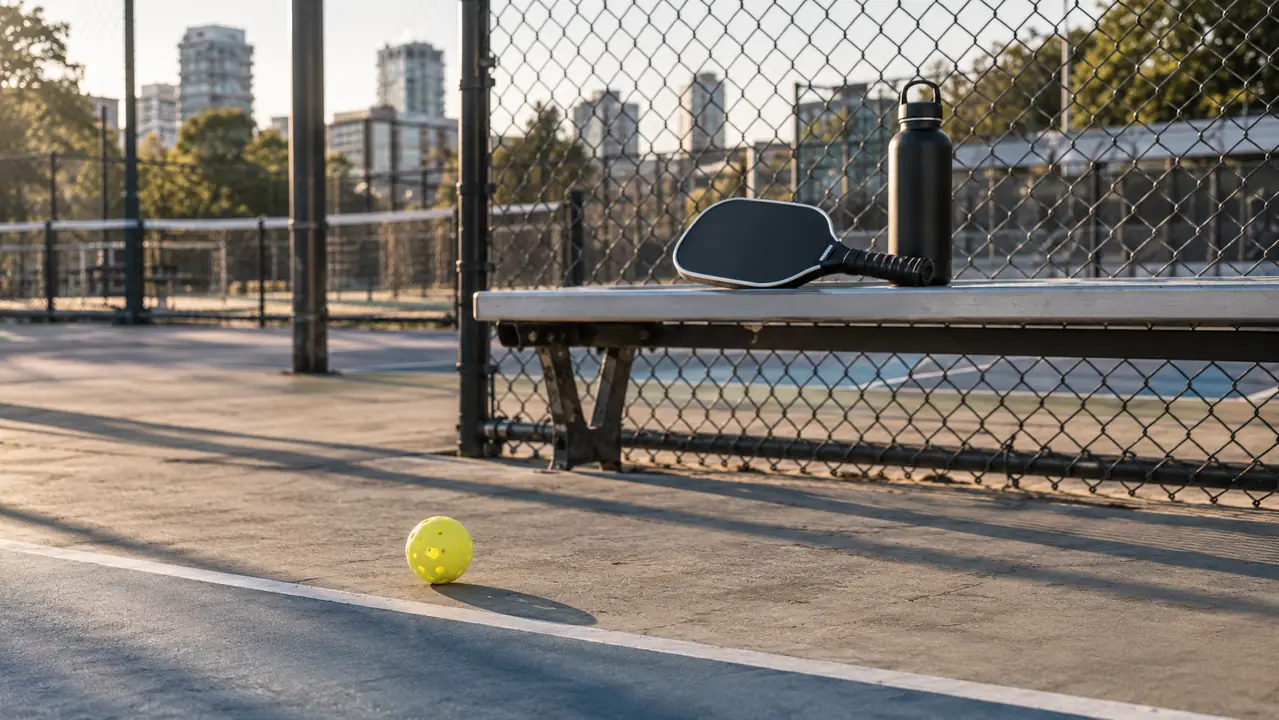
You can hear it before you can prove it. The ball comes off the paddle with a flat thump instead of a pop, your third shot lands a foot short, and somebody across the net says it is still good, because nobody wants to walk back to the bag in the middle of a game.
I know that morning. Late March, the outdoor courts at the city rec center here in Knoxville, second game of the day. A ball from the rec center bucket split along the mold line mid-rally and rolled under the fence. Nobody had a spare. We spent five minutes at the net squeezing the rest of the bucket and arguing about which ones were dead, then played the last two games with a ball none of us trusted. That afternoon I ordered a three-pack of Franklin Sports X-40 outdoor balls and stopped depending on whatever happened to be in the bucket. I have gone through a few packs since. What follows is the order I check them in now, usually while I am waiting for a court to open up. No gauge, no meter, just your hands and about two minutes.
The three-pack that lives in my bag so a split seam never ends a rally
Franklin Sports X-40 outdoor balls, USAP approved, 40 drilled holes, 2.91 inches across, one-piece rotational molded shell. One in play, two in reserve.
Amazon Check Today's Price on Amazon →Five Checks, in the Order I Do Them
Step 1: Drop it on concrete from about waist height
This is the oldest test there is and it still does most of the work. Hold the ball at about waist height, arm straight out, and drop it on the concrete apron outside the fence. Not the court surface. The court has a little give to it and it will flatter a tired ball. Watch how high it comes back.
A ball with life left in it comes back somewhere around your knee. A ball that has gone soft comes back visibly lower, and it lands with a flat smack instead of a snap. You do not need a number or a chart. Drop a new one and an old one side by side and the difference will embarrass you, because most of us have been happily playing with the low one for a month.
Do it three times. The first drop is a liar. A ball with a crack you cannot see yet will sometimes bounce fine on the first try and then fall dead on the third. If the three bounces do not come back to roughly the same height, that is your answer, and you can stop reading this section and go get a different ball.
Step 2: Squeeze it hard between your thumb and fingers
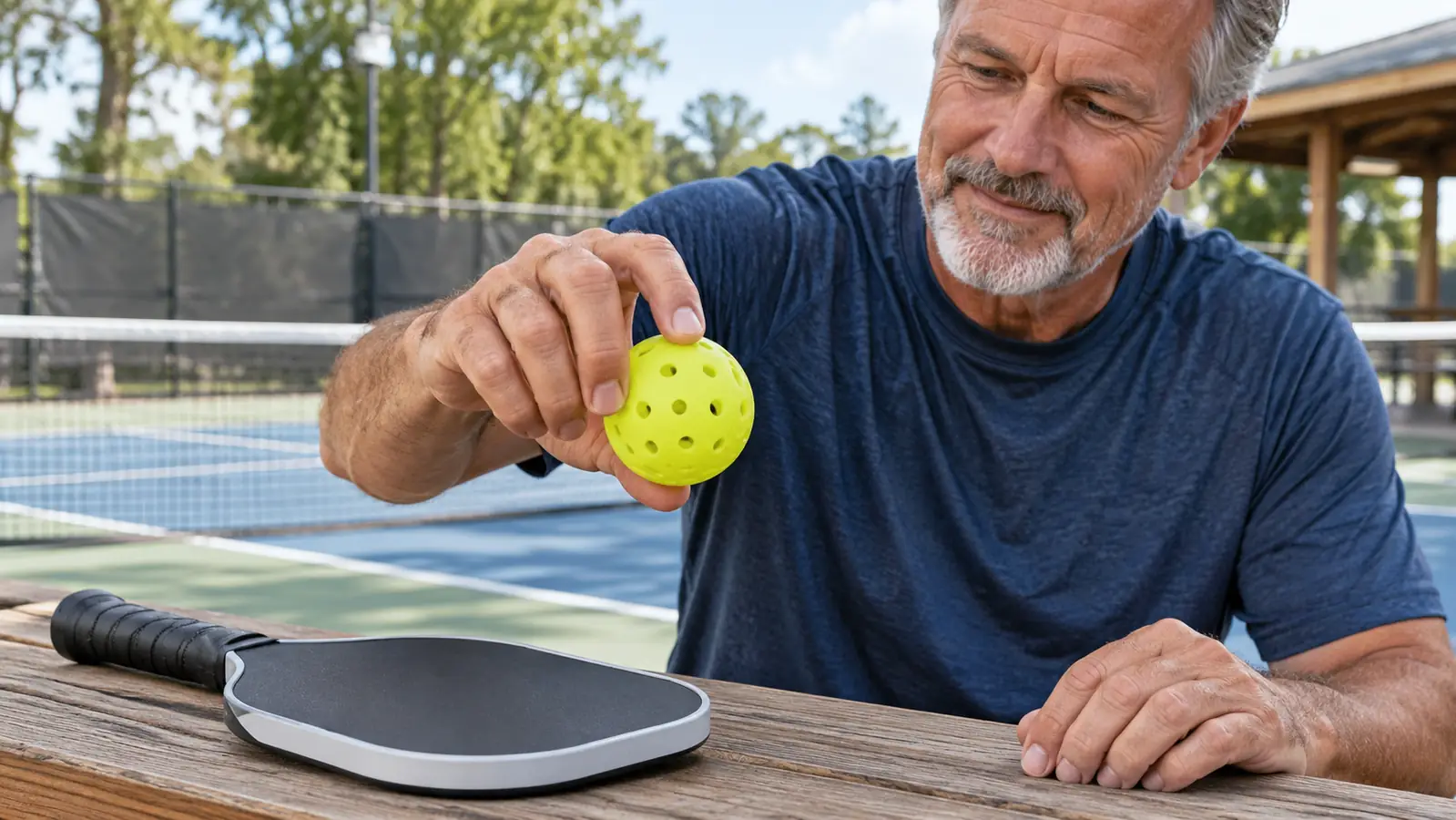
Squeeze the ball between your thumb and your first two fingers, first around the middle, then around each end. You are not trying to crush it. You are trying to find the spot that gives.
A polyethylene shell should push back at you and then spring. What you are hunting for is a soft place, a section where your thumb sinks in a little and stays sunk for a second. That is a wall that has been beaten thin by a few hundred serves and a few thousand dinks. It will still fly straight on a slow shot and it will die on anything hard, which is exactly the kind of ball that makes you think your paddle has gone bad.
Listen while you do it. A good ball gives a crisp click. A papery crunch or a dull creak means there is a hairline crack starting at one of the holes, and that ball is finished even if the drop test says otherwise. I have pulled three balls out of the bag on that sound alone this summer, and two of them split within the week.
Four of us stood at the net squeezing a ball nobody wanted to throw away. That is the whole problem with a worn-out pickleball. It dies slowly, and we all pretend we cannot tell.
Step 3: Look at the holes, not the smooth panels
Turn the ball slowly under good light and look at the holes rather than the smooth panels between them. Cracks almost never start in the middle of a panel. They start where the shell was cut.
What you are looking for is a short line running from one hole toward another, a white stress mark at the rim, or a chip missing from the edge of a hole. The Franklin Sports X-40 has 40 drilled holes, and every one of them is a place where the wall is thinner and takes the hit. A crack that runs hole to hole is done. A hole that has gone oval, or one with a chunk out of the rim, is done too.
Wipe the ball with your thumb first. Half the cracks I have found were hiding under a smear of court dust. And check the mold line. The X-40 is a one-piece rotational molded shell, so there is no joined seam to split, but you will still see a faint line where the mold closed, and a crack that follows it goes all the way through. That is the crack that split the rec center ball in March.
Step 4: Roll it and watch for the wobble
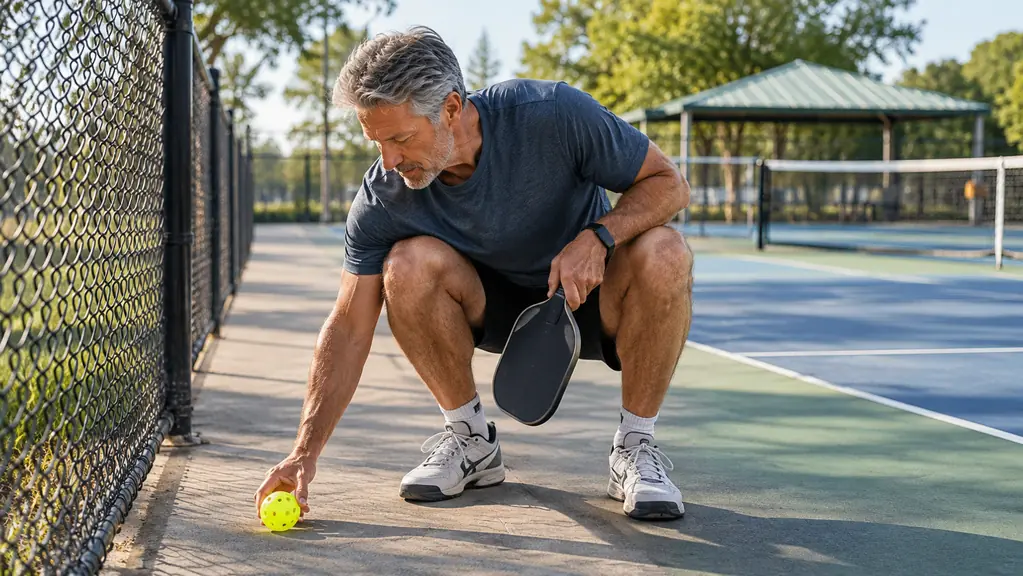
Find a flat bench, a picnic table, or a clean stretch of concrete and let the ball roll. Give it a light push and then take your hand away.
A worn ball wanders. It drifts left or right, or it slows down in one spot like it is dragging a foot, or it wobbles instead of rolling smooth. That means the shell has deformed, usually from heat or from being hit on the same spot a few thousand times. A ball that is not round flies like a ball that is not round, and you will spend the rest of the morning wondering why your serves keep sailing long.
I check this more carefully in August than in April. A ball that rides around in a hot car all week goes out of round faster than one that lives in a bag inside the house. The CR-V gets hot enough in a Knoxville summer to cook an egg on the dashboard, and I have learned not to leave the three-pack sitting in there between sessions.
Step 5: Judge it in play, by sound and by where it lands
The court tells you things the bench cannot. The first clue is sound. A good ball pops off the paddle. A tired ball thuds. Once you hear it you cannot unhear it, and you will start noticing that half the shared bucket sounds like a wet newspaper hitting a garage door.
The second clue is where the ball lands. A worn ball drops short on the swing that used to put it deep. It also starts knuckling, meaning it wobbles in the air instead of holding its line. That is the one that costs you points, because you aim for the middle of the court and the ball decides to go somewhere else entirely.
The ball that fools everybody is the one that looks fine and plays dead. If you and your partner are making the same shot and one ball keeps coming up short, mark that ball with a dot and set it aside. Do not drop it back in the bucket for somebody else to deal with. Phil and I have a rule about this now, and the rule is that the person who finds the dead ball gets to throw it in the trash without a committee meeting.
What Else Helps
Rotate instead of ration. I keep a three-pack and I mark the balls with a dot so I know which one has been in play the longest. One goes in the bag as the gamer, one is the spare, one waits. When the gamer starts failing Step 1, it moves down the line instead of staying in the rotation because I am too cheap to retire it. That small habit has done more for my consistency than any paddle change I have made.
Retire dead balls to a practice bucket rather than the trash. A ball that has gone soft is still useful for serves and dinks in the driveway, and it is honest practice, because it forces you to swing through the ball instead of letting the ball do the work. Just do not mix them back in with the good ones. I keep the practice balls in a separate zip pocket on the bag so there is no confusion at the court.
Cold mornings shorten the life of an outdoor ball. The Franklin Sports X-40s I buy crack faster once the temperature drops, which is one more reason I move indoors to the gym when the weather turns. The gym supplies its own indoor balls, and I leave them alone, the same way I do not bring my outdoor three-pack onto a gym floor. They are built for different surfaces and they behave differently, and mixing them up just makes everybody's shots look worse than they are.
Do not trust a bucket you did not fill. The shared bucket at the rec center is a kindness and a trap. Somebody donates three good balls, somebody else donates four that have been in a garage since 2019, and by the time it reaches you it is a grab bag. I still use the bucket for warmups, but I start every real game with a ball I brought. It has cut down on the mid-rally negotiation to almost nothing.
Franklin Sports puts a 90 day limited warranty on the X-40. I have never filed one and I am not going to tell you it is a reason to keep playing with a cracked ball, because it is not. A ball that fails the squeeze test is a ball that is going to let you down in a rally you care about, and no paperwork changes that. I mention it only because it is on the box and you should know it is there.
One more thing, and this is the part I had to learn the hard way. Do not decide a ball is bad because of one shot. I have blamed a ball for a serve I dumped into the net when the truth was that I did not get my feet set. Run the five checks at the bench, make your call before the first serve, and then leave it alone for the rest of the morning. Second-guessing the ball mid-game is just another way of not thinking about your own footwork.
None of this is complicated and none of it costs anything but two minutes. Drop it, squeeze it, look at the holes, roll it, and then listen to it on the court. If a ball fails two of those five, it is done. If it passes all five, stop worrying about it and go play. The ball is the cheapest piece of equipment in the bag and the easiest one to get right, and getting it right is the difference between a rally that ends the way you planned and one that ends with four people staring at the net.
Two minutes at the bench beats five minutes arguing at the net
Franklin Sports X-40 outdoor balls. USAP approved, 40 holes, one-piece rotational molded shell, 2.91 inches across. Three to a pack, one in play and two waiting.
Amazon Check Today's Price on Amazon →